1 Introduction: The End of Ambiguity
Product development in software has always carried a paradox: the more detail you add to requirements, the more room there seems to be for misinterpretation. Even the most carefully worded Product Requirement Document (PRD) can collapse under the weight of ambiguity once engineering teams attempt to implement it. For senior developers, tech leads, and solution architects, this isn’t just a nuisance—it’s a costly, systemic drag on velocity.
1.1 The Universal Pain Point
Picture this: you’re a senior developer, and your product manager just dropped a 15-page PRD into your lap. At first glance, it looks thorough—tables, bullet points, diagrams. But as you read, the cracks show:
- “Provide a seamless user experience.”
- “Ensure robust backend processing.”
- “Make the system scalable.”
All noble goals—but what do they mean in code? What does seamless translate to in terms of API response time? What does robust mean for transaction retries, or scalable for concurrent users?
You know what comes next. Weeks of clarification meetings. Slack threads that stretch into novels. JIRA “tennis” where tickets bounce endlessly between engineering and product. Eventually, code ships—but hidden inside are dozens of small “lost-in-translation” bugs. Developers guessed at intent. Testers filled in missing acceptance criteria on the fly. Architects assumed constraints that weren’t actually there. On average, each PRD generates 15–20 clarifications, adding 7–10 days of delay to delivery schedules.
This isn’t a hypothetical story. Multiple studies confirm that poor requirements are the leading cause of project overruns:
- The Standish Group’s 2023 CHAOS Report found that over 40% of project failures can be directly attributed to unclear or changing requirements.
- McKinsey estimated that up to 80% of rework costs in software projects stem from requirements gaps and ambiguities.
- PMI’s Pulse of the Profession noted that organizations waste nearly 12% of investment on failed projects due to poor requirement practices.
The pattern is depressingly consistent: unclear input leads to unclear output, no matter how skilled the engineering team is.
1.2 The Core Problem
At its root, the problem isn’t lack of effort. It’s structural. Today, the bridge between business intent (a PRD written in human language) and engineering execution (code, tests, infrastructure) is entirely manual. Humans read a narrative description and try to map it into structured technical artifacts. That analog bridge is:
- Lossy: Nuance is lost in translation. The meaning of “real-time” to a PM may mean sub-second; to a developer, it may mean “within a minute.”
- Slow: It takes weeks of human negotiation to resolve ambiguities.
- Expensive: Every clarification costs meetings, attention, and context-switching.
We’ve accepted this as normal because until recently, we had no viable alternative. The requirements-to-specification step has always been the most human-dependent part of software engineering.
But 2025 marks a turning point.
1.3 The Paradigm Shift: From LLM Chatbots to Autonomous Agents
In 2023 and 2024, many teams experimented with large language models (LLMs) like GPT-4, Claude, and Gemini. The results were promising but limited. Ask an LLM to “write an API spec from this PRD,” and it might spit out something plausible—but brittle. Prompt-and-response interaction lacks persistence, coordination, and structured reasoning. It’s like asking a very smart intern to draft something quickly, without checking assumptions or cross-referencing with other specialists.
The real leap forward is the rise of autonomous, multi-agent AI systems. Unlike a single chatbot, a system of AI agents can:
- Reason in loops: Analyze a PRD, generate clarifying questions, critique its own output, and refine iteratively.
- Decompose problems: Break a monolithic requirement into smaller, structured tasks.
- Specialize: Use distinct “roles” for different kinds of technical artifacts—APIs, schemas, user stories, acceptance criteria.
- Collaborate: Agents can critique, correct, and coordinate with each other, mirroring the dynamics of a real engineering team.
Instead of handing vague PRDs to humans, you can feed them to an AI-driven pipeline that outputs:
- User stories and epics ready for JIRA.
- API definitions in OpenAPI 3.0.
- Database schemas in SQL or Mermaid diagrams.
- Acceptance criteria in Gherkin syntax.
- System diagrams and architectural proposals.
What used to take weeks of back-and-forth can now take hours, with engineers focusing on validation and refinement instead of raw translation.
1.4 What This Article Will Deliver
This guide is written for senior developers, architects, and tech leads who are already fluent in both business conversations and codebases. Our aim is not to sell hype, but to provide a practical, end-to-end blueprint. Specifically, you will learn:
- How to define and structure AI agents that mirror the roles of a modern software team.
- How to design a multi-agent pipeline that takes a PRD as input and outputs a production-ready technical specification.
- Which tools and frameworks (Autogen, LangChain, LlamaIndex) to use for orchestration, reasoning, and retrieval.
- What pitfalls to avoid—from hallucinations to over-engineering—and how to enforce structured, machine-usable outputs.
- How to start small with proof-of-concepts and scale toward a fully integrated, AI-augmented engineering workflow.
Scope note: This blueprint is intended for product-type web services and data-backed applications. It does not cover hard real-time systems, embedded software, or other domains where deterministic guarantees and low-level hardware constraints dominate.
By the end, you’ll have a clear understanding of not just why AI agents are the right tool for this job, but also how to implement them effectively in your organization.
Here’s a revised version of your Section 2 with the requested improvements integrated. I kept the same tone, structure, and flow, while adding the diagram reference, comparison table, and sidebars.
2 The Foundation: Why AI Agents are the Right Tool for This Job
To build trust in a new paradigm, you need to understand both the moving parts and the mental models behind them. Let’s ground ourselves before diving into architecture.
2.1 Defining the Modern AI Agent
An AI agent in 2025 is not just a chatbot with memory. It’s a programmable entity that can perceive input, reason about it, act using tools, and remember context over time. Think of it as a software developer with three unique abilities:
- Cognitive reasoning powered by an LLM (e.g., GPT-4o, Claude 3.5 Sonnet, Gemini 1.5 Pro).
- Structured memory spanning both short-term (active conversation) and long-term (retrieved via vector databases like ChromaDB or Pinecone).
- Actionability through APIs, code interpreters, and integrations with external systems.
At its core, a modern AI agent comprises four components:
2.1.1 The LLM as Reasoning Engine
The language model provides flexible reasoning and generative capabilities. Instead of being hard-coded, it adapts to new domains, making it suitable for parsing PRDs, drafting specs, and critiquing outputs.
2.1.2 Memory
Two forms of memory are essential:
- Short-term context: The working conversation window.
- Long-term memory: Persisted embeddings in a vector DB that allow agents to recall past decisions, architectural conventions, or domain-specific rules.
Without memory, every agent behaves like a goldfish—brilliant in the moment, but forgetful.
2.1.3 Tools
Agents can call external functions, such as:
- Searching a company’s internal Confluence.
- Running code to validate a schema.
- Generating diagrams with MermaidJS.
- Creating JIRA tickets via API.
Tools turn reasoning into grounded action.
2.1.4 Planning/Reasoning Loop
Frameworks like ReAct (Reason + Act) allow agents to plan: they think, take actions with tools, reflect on outcomes, and iterate until the task is complete. This closes the loop between intent and result.
An agent, therefore, isn’t “just an LLM.” It’s closer to a junior engineer with Google access, IDE plugins, and a good memory.
2.2 Single Agent vs. Multi-Agent Systems (MAS)
Why not just build one super-agent that does everything? The answer lies in complexity and specialization.
A single generalist agent struggles when tasks require deep, domain-specific rigor. For instance, generating a correct OpenAPI spec demands different reasoning than designing a relational schema or drafting test cases.
The analogy is architectural:
- Single agent: Hiring a “jack of all trades” to build a skyscraper. They might sketch a blueprint, pour some concrete, and wire the lights—but would you trust them with earthquake safety?
- Multi-agent system: Hiring an architect, structural engineer, electrician, and safety inspector, each specialized, but coordinated.
Comparison of Single vs. Multi-Agent Approaches
| Factor | Single Agent | Multi-Agent System |
|---|---|---|
| Complexity | Simple to design and deploy | Higher coordination overhead |
| Cost | Lower infra and orchestration cost | Higher due to multiple agents |
| Latency | Faster for small tasks | May add communication overhead |
| Reliability | Risk of error propagation | Higher due to checks and balances |
Sidebar: When to Use a Single Agent A single agent works best when:
- The task is narrow and well-bounded.
- Reliability requirements are modest.
- Cost and speed matter more than rigor. Examples include summarization, document drafting, and simple Q&A.
For high-stakes, complex pipelines (like PRD-to-spec transformation), multi-agent systems are the safer choice.
2.3 Key Open-Source Frameworks to Know
To implement such systems, you don’t need to start from scratch. Three frameworks stand out as of 2025:
2.3.1 Microsoft Autogen
Autogen is designed for building conversational, collaborative multi-agent systems. It provides:
- Agents that can converse with each other.
- Delegation and task handoff mechanisms.
- Built-in memory and tool integrations.
For our pipeline, Autogen will be the primary orchestration framework.
2.3.2 LangChain Agents
LangChain has matured into a robust toolkit for single-agent applications with tools and memory. It excels at:
- Building domain-specific specialist agents.
- Providing adapters for tools (APIs, code execution, RAG).
- Interfacing with multiple LLM providers.
Think of LangChain as the construction kit for individual digital specialists.
2.3.3 LlamaIndex
Formerly known as GPT Index, LlamaIndex focuses on retrieval-augmented generation (RAG). It allows you to:
- Index technical documentation, existing specs, or Confluence pages.
- Provide semantic search to agents.
- Ground generation in factual, company-specific knowledge.
Without RAG, agents risk hallucination. With it, they operate on verifiable context.
3 Architectural Blueprint: The PRD-to-Spec AI Pipeline
With the fundamentals in place, let’s move from theory to architecture. The goal is to design a system that ingests a human-written PRD and outputs precise, production-ready specifications. This pipeline must be structured, modular, and flexible enough to handle real-world variance in PRD quality while maintaining speed and accuracy.
3.1 High-Level Overview
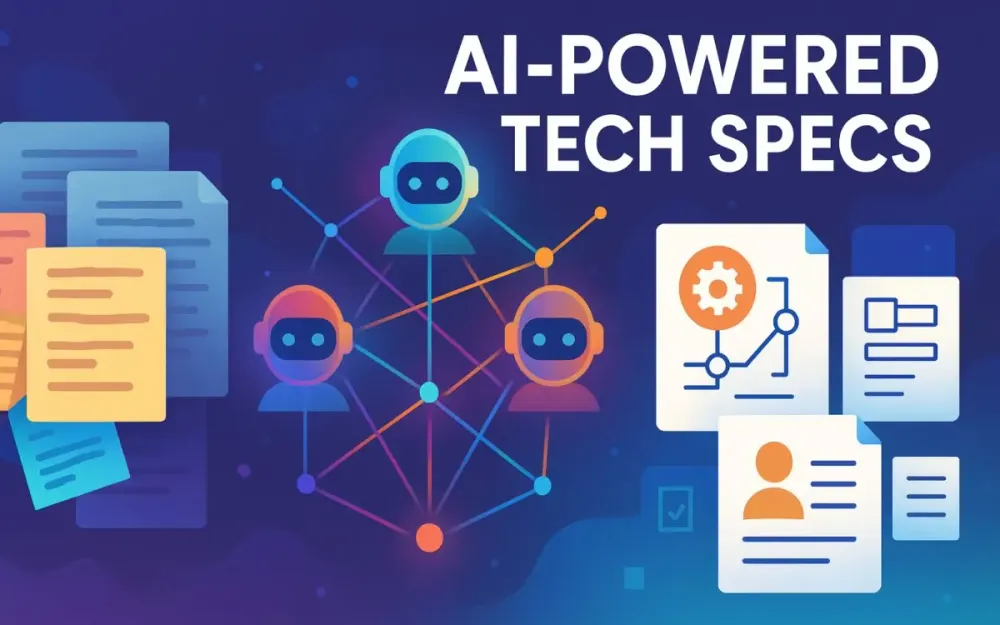
Think of the PRD-to-spec pipeline as a software factory line. Raw input (a PRD) enters, is shaped and clarified at successive stages, and finally exits as a polished, structured technical artifact. Each stage is handled by a specialized digital worker, coordinated by an Orchestrator Agent.
A simplified view of the architecture looks like this:
flowchart TD
    A[PRD Input: Confluence/Google Docs/Notion] --> B[Stage 1: Ingestion & Contextualization]
    B --> C[Stage 2: Disambiguation & Clarification]:::hitl
    C --> D[Stage 3: Decomposition & Delegation]
    D --> E[Stage 4: Parallelized Specification Generation]
    E --> F[Stage 5: Synthesis & Review]:::hitl
    F --> G[Final Technical Specification]

classDef hitl fill=#ffcccc,stroke=#ff0000,stroke-width=2px;
Two explicit human-in-the-loop checkpoints exist: after Clarifications (Stage 2) and before Synthesis (Stage 5). These are mandatory pauses where stakeholder input validates AI output.
Key principles in this pipeline:
- Separation of concerns: Each stage has a clear responsibility.
- Human-in-the-loop at critical points: Clarification questions are surfaced before downstream work multiplies ambiguity.
- Structured outputs enforced: JSON, YAML, Mermaid, and Gherkin outputs prevent drift into prose.
- Parallelism where safe: Specialized agents can work simultaneously to accelerate throughput.
By making the pipeline explicit, we move away from ad-hoc prompting and toward a predictable, repeatable process.
3.2 The Five Core Stages of Transformation
Each stage addresses a different aspect of the ambiguity problem. Let’s break them down with concrete details and examples.
3.2.1 Stage 1: Ingestion & Contextualization
The process begins with ingestion. The system must be able to read a PRD from common sources: Confluence pages, Google Docs, Notion databases, or even markdown files in Git repositories. At this point, raw text is not enough. Context is everything.
To enrich the PRD, we apply retrieval-augmented generation (RAG). For example:
- Index past JIRA tickets to discover how similar features were implemented.
- Search existing API documentation to avoid redundant designs.
- Query architecture diagrams to align with established microservices.
A Python snippet using LlamaIndex for contextualization might look like this:
from llama_index import VectorStoreIndex, SimpleDirectoryReader

# Load existing architecture docs, API specs, and schemas
docs = SimpleDirectoryReader("./tech_docs").load_data()

# Build an index for retrieval
index = VectorStoreIndex.from_documents(docs)

# Query with PRD content
prd_text = open("prd_smart_shopping_list.txt").read()
query_engine = index.as_query_engine()
context = query_engine.query(f"Provide relevant context for: {prd_text}")

print(context)
The output becomes a context-enriched PRD. This is the first safeguard against hallucination: the agents are not working in a vacuum.
3.2.2 Stage 2: Disambiguation & Clarification
Next, the primary agent scans the PRD for ambiguity. This stage surfaces hidden risks before they propagate downstream.
For example, given the line: “The system should support a large number of concurrent users.” The agent might ask:
- What is the expected concurrency (hundreds, thousands, millions)?
- Are there latency SLAs defined?
- Do we need horizontal scaling at the database level?
The output here is not a specification, but a structured set of clarifying questions. A typical JSON format could be:
{
  "clarifications": [
    {
      "requirement": "Support large number of concurrent users",
      "questions": [
        "What is the expected number of concurrent users at launch?",
        "What latency thresholds must be met (p95, p99)?",
        "Are there regional traffic distribution requirements?"
      ]
    }
  ]
}
At this stage, a product manager or stakeholder is looped in to resolve ambiguity. This is the human-in-the-loop checkpoint—a deliberate pause where human domain knowledge aligns with AI reasoning.
3.2.3 Stage 3: Decomposition & Delegation
Once ambiguities are resolved, the Orchestrator Agent decomposes the PRD into atomic tasks. This step transforms high-level requirements into actionable work packages.
Example PRD statement: “Users can manage shopping lists with categorized items.”
Decomposition might yield:
-
User Stories:
- “As a user, I can create a shopping list.”
- “As a user, I can add items to a shopping list.”
- “As a user, I can view items grouped by category.”
-
API Design Task:
- Define endpoints for
POST /lists,GET /lists/{id},POST /lists/{id}/items.
- Define endpoints for
-
Database Schema Task:
- Create
lists,items, andcategoriestables with relationships.
- Create
Delegation is where specialization begins. The Orchestrator assigns these tasks to relevant agents—Product Analyst, API Designer, Database Agent, etc. This mirrors how a human tech lead delegates work.
3.2.4 Stage 4: Parallelized Specification Generation
Specialist agents now generate artifacts in parallel. Because tasks are independent, this stage is where speed gains compound.
For example:
- API Designer Agent produces OpenAPI YAML:
paths:
  /lists:
    post:
      summary: Create a shopping list
      requestBody:
        content:
          application/json:
            schema:
              $ref: '#/components/schemas/ShoppingList'
      responses:
        '201':
description: List created- Database Agent outputs SQL DDL:
CREATE TABLE lists (
    id UUID PRIMARY KEY,
    name VARCHAR(255) NOT NULL,
    created_at TIMESTAMP DEFAULT NOW()
);

CREATE TABLE items (
    id UUID PRIMARY KEY,
    list_id UUID REFERENCES lists(id),
    name VARCHAR(255) NOT NULL,
    category VARCHAR(100),
    created_at TIMESTAMP DEFAULT NOW()
);- QA Agent generates Gherkin acceptance tests:
Feature: Shopping List Management
  Scenario: Add item to a shopping list
    Given a shopping list exists
    When the user adds "Bananas" to the list
    Then the list should include "Bananas"
Running these in parallel not only saves time but also prevents context drift—each agent focuses narrowly on its expertise.
3.2.5 Stage 5: Synthesis & Review
Finally, the Orchestrator Agent collects outputs, validates consistency, and synthesizes them into a unified specification. This includes:
- Cross-checking entity names between API and database schema.
- Ensuring user stories align with acceptance criteria.
- Validating OpenAPI YAML for correctness.
The assembled deliverable is a specification package, for example:
specs/openapi.yamlspecs/schema.sqlspecs/user_stories.mdspecs/acceptance_tests.feature
At this point, a senior engineer reviews the package. Their job is no longer to draft from scratch, but to validate and adjust. This drastically reduces cycle time while maintaining accountability.
Consistency Contract: All naming conventions are centralized into a single “Conventions” artifact. This defines:
- Endpoints: kebab-case (e.g.,
/shopping-lists/{id}) - Schemas/fields: snake_case (e.g.,
created_at) - Headers: Pascal-Case (e.g.,
X-Request-Id) - operationId: camelCase (e.g.,
createShoppingList)
By defining these once, every artifact (API, DB, tests) adheres to the same canonical policy.
3.2.6 Traceability Matrix
To ensure no requirement is lost in translation, the pipeline generates a traceability matrix. This links each PRD requirement to user stories, API endpoints, and test scenarios.
Example:
| PRD Requirement | User Story | API Endpoint | Test Scenario |
|---|---|---|---|
| Manage shopping lists with categories | “As a user, I can create a shopping list.” | POST /shopping-lists | Add list and verify creation |
| “As a user, I can add categorized items.” | POST /shopping-lists/{id}/items | Add item with category and check | |
| “As a user, I can view items by category.” | GET /shopping-lists/{id} | Verify grouping by category |
This artifact is critical for audits and aligns engineering outputs with business intent.
3.3 The Cast of Digital Specialists: Defining Your Agent Roles
A multi-agent system succeeds or fails on role clarity. Each agent must be narrowly scoped, with responsibilities and outputs defined. Let’s map the digital team.
3.3.1 The Orchestrator Agent (The Tech Lead)
The Orchestrator is the conductor of the digital orchestra. Responsibilities include:
- Parsing PRD tasks into sub-problems.
- Delegating tasks to specialist agents.
- Integrating results into a coherent whole.
- Identifying inconsistencies across outputs.
A sample Autogen definition might look like:
from autogen import ConversableAgent

orchestrator = ConversableAgent(
    name="OrchestratorAgent",
    system_message="You are the Tech Lead. Break down PRD requirements, assign tasks to other agents, and synthesize outputs into a unified specification."
)
3.3.2 The Product Analyst Agent
The Analyst specializes in translating business requirements into actionable engineering inputs:
- Identifies features, personas, and rules.
- Produces user stories and epics.
- Highlights edge cases.
Example output (Markdown for JIRA import):
## Epic: Shopping List Management
- As a user, I can create a new shopping list.
- As a user, I can add items to my shopping list.
- As a user, I can categorize items for better organization.
3.3.3 The System Architect Agent
This agent owns the “big picture”:
- Considers scalability, performance, and security.
- Suggests high-level diagrams.
- Identifies microservices and their boundaries.
For example, outputting a Mermaid diagram:
graph TD
    A[User] --> B[Frontend]
    B --> C[List Service]
    B --> D[Recipe Service]
    C --> E[Database]
    D --> F[ML Categorization Service]
3.3.4 The API Designer Agent
Specialized in generating valid OpenAPI/GraphQL specifications. Strengths include:
- Converting user stories into endpoints.
- Defining request/response schemas.
- Validating against OpenAPI standards.
For example, an endpoint spec:
components:
  schemas:
    ShoppingList:
      type: object
      properties:
        id:
          type: string
          format: uuid
        name:
          type: string
3.3.5 The Database Schema Agent
Responsible for relational or NoSQL design. Outputs:
- SQL DDL scripts.
- ER diagrams.
- Migration scripts.
Example output (Mermaid ER diagram):
erDiagram
    LISTS ||--o{ ITEMS : contains
    LISTS {
        UUID id
        string name
    }
    ITEMS {
        UUID id
        string name
        string category
    }
3.3.6 The Frontend Agent
While backend agents define APIs and schemas, the Frontend Agent proposes UI structures:
- Component breakdowns.
- State management flows.
- Wireframe-level suggestions.
Sample output (React component hierarchy):
App
 └── ShoppingListPage
      ├── ListHeader
      ├── ItemList
      │    ├── ItemRow
      │    └── AddItemForm
      └── CategorySidebar
3.3.7 The QA Agent
This agent ensures testability from day one:
- Generates Gherkin acceptance tests.
- Maps tests to user stories.
- Identifies missing negative cases.
Example Gherkin:
Scenario: Categorize item in shopping list
  Given a shopping list contains "Milk"
  When the user assigns category "Dairy" to "Milk"
  Then "Milk" should be listed under "Dairy"
4 Practical Implementation: Building the Pipeline with Autogen & Claude 3.5 Sonnet
This section turns the blueprint into code you can run. We’ll create a minimal but extensible stack: Autogen to coordinate conversations among role-based agents, Claude 3.5 Sonnet (and optionally GPT-4o) for reasoning, and a LlamaIndex + ChromaDB RAG layer to ground generation on your internal docs. By the end, you’ll have a working skeleton that ingests a PRD, asks clarifying questions, decomposes work, and emits machine-checked artifacts (OpenAPI YAML, SQL DDL, and Gherkin) in a single pass. The examples favor clarity and composability over clever abstractions, so you can adapt them to your stack and deployment requirements.
4.1 Setting Up the Environment
We’ll use Python 3.11+, pyautogen (Microsoft Autogen), LlamaIndex, ChromaDB, SDKs for Anthropic/OpenAI, and a few utilities for validation and YAML handling. Keep secrets outside your repo and prefer per-environment config.
# Python toolchain
pyenv install 3.11.9 && pyenv local 3.11.9
python -m venv .venv && source .venv/bin/activate   # Linux/Mac
# On Windows PowerShell:
.\.venv\Scripts\activate
# (If execution policy blocks this: Set-ExecutionPolicy -Scope Process -ExecutionPolicy Bypass)

# Core libraries
pip install "pyautogen>=0.2.0" "anthropic>=0.30" "openai>=1.40" \
            "llama-index>=0.10" "chromadb>=0.5" "tiktoken" "python-dotenv" \
            "pydantic>=2.7" "jsonschema>=4.22" "pyyaml" "openapi-spec-validator>=0.7" \
            "rich" "typer"

# Node.js setup (required for Mermaid CLI)
npm i -g @mermaid-js/mermaid-cli
CI/CD runners must include Node.js so that mmdc (Mermaid CLI) is available for diagram rendering.
Use .env for keys and a small settings.yaml to keep model routing centralized.
# .env (do not commit)
ANTHROPIC_API_KEY=sk-ant-...
OPENAI_API_KEY=sk-live-...
# settings.yaml
models:
orchestrator:
provider: anthropic
name: claude-3-5-sonnet
specialists:
provider: openai
name: gpt-4o
rag:
persist_dir: ./.rag/chroma
top_k: 6
project:
name: prd_to_spec
out_dir: ./specsA tiny loader helps read config and secrets.
# config.py
from dataclasses import dataclass
from pathlib import Path
import os, yaml
from dotenv import load_dotenv

@dataclass
class ModelCfg:
    provider: str
    name: str

@dataclass
class Settings:
    orchestrator: ModelCfg
    specialists: ModelCfg
    rag_persist: str
    rag_top_k: int
    out_dir: Path

def load_settings() -> Settings:
    load_dotenv()
    with open("settings.yaml") as f:
        y = yaml.safe_load(f)
    return Settings(
        orchestrator=ModelCfg(**y["models"]["orchestrator"]),
        specialists=ModelCfg(**y["models"]["specialists"]),
        rag_persist=y["rag"]["persist_dir"],
        rag_top_k=y["rag"]["top_k"],
        out_dir=Path(y["project"]["out_dir"]).absolute()
    )
4.2 Step 1: The RAG Context Engine with LlamaIndex
We’ll index your tech docs (architecture decisions, existing API specs, past RFCs) and expose a rag_search() tool to all agents. The tool should return short, citation-rich snippets—not walls of text—so agents can reason with relevant facts.
# rag.py
from llama_index.core import VectorStoreIndex, SimpleDirectoryReader, StorageContext, load_index_from_storage
from llama_index.vector_stores.chroma import ChromaVectorStore
import chromadb
from typing import List, Dict

class RAG:
    def __init__(self, persist_dir: str):
        self.persist_dir = persist_dir
        self.client = chromadb.PersistentClient(path=persist_dir)

    def build_or_load(self, docs_dir: str) -> VectorStoreIndex:
        try:
            chroma_collection = self.client.get_or_create_collection("tech_docs")
            storage = StorageContext.from_defaults(vector_store=ChromaVectorStore(chroma_collection=chroma_collection))
            # Attempt to load existing index; if fails, (re)build
            return load_index_from_storage(storage)  # type: ignore
        except Exception:
            documents = SimpleDirectoryReader(docs_dir, recursive=True).load_data()
            chroma_collection = self.client.get_or_create_collection("tech_docs")
            storage = StorageContext.from_defaults(vector_store=ChromaVectorStore(chroma_collection=chroma_collection))
            index = VectorStoreIndex.from_documents(documents, storage_context=storage)
            return index

class RAGTool:
    def __init__(self, index: VectorStoreIndex, top_k: int):
        self.query_engine = index.as_query_engine(similarity_top_k=top_k)

    def search(self, query: str) -> List[Dict]:
        """Return list of {text, source} dicts."""
        resp = self.query_engine.query(query)
        items = []
        for node in getattr(resp, "source_nodes", []):
            items.append({
                "text": node.node.get_text()[:1200],
                "source": node.node.metadata.get("file_path", "unknown")
            })
        return items
Wire up RAG and expose it as a callable function the agents can invoke.
# tools.py
from typing import List, Dict
from rag import RAG, RAGTool

_rag_tool: RAGTool | None = None

def init_rag(docs_dir: str, persist_dir: str, top_k: int) -> None:
    global _rag_tool
    engine = RAG(persist_dir).build_or_load(docs_dir)
    _rag_tool = RAGTool(engine, top_k)

def rag_search(query: str) -> List[Dict]:
    if _rag_tool is None:
        raise RuntimeError("RAG not initialized")
    return _rag_tool.search(query)
Expose a concise JSON contract for the tool: ask agents to provide a one-sentence intent and the raw query; return a bounded list of snippets plus file paths. Short, typed responses are easier to reason over and validate.
# Example call path for later
# results = rag_search("Show prior decisions about idempotency and retries for list-service")
# -> [{'text': 'ADR-004: All POST endpoints must be idempotent via Idempotency-Key header...', 'source': 'adr/adr-004-idempotency.md'}, ...]
4.3 Step 2: Defining the Agents in Autogen
You’ll define the Orchestrator and six specialists. Keep prompts crisp: responsibilities, inputs, and required outputs with schemas or file formats. Route the Orchestrator to Claude 3.5 Sonnet for stronger planning and critique; use GPT-4o (or your chosen alternative) for specialists to balance latency and cost.
# agents.py
from autogen import ConversableAgent
from config import load_settings
from tools import rag_search

settings = load_settings()

def model_cfg(provider: str, name: str) -> dict:
    if provider == "anthropic":
        return {"model": name, "api_key": os.environ["ANTHROPIC_API_KEY"], "provider": "anthropic"}
    elif provider == "openai":
        return {"model": name, "api_key": os.environ["OPENAI_API_KEY"], "provider": "openai"}
    else:
        raise ValueError(f"Unknown provider: {provider}")

import os, json

ORCH_CFG = model_cfg(settings.orchestrator.provider, settings.orchestrator.name)
SPEC_CFG = model_cfg(settings.specialists.provider, settings.specialists.name)

def make_orchestrator() -> ConversableAgent:
    return ConversableAgent(
        name="Orchestrator",
        system_message=(
            "Role: Tech Lead orchestrating a multi-agent pipeline from PRD to specs.\n"
            "Responsibilities:\n"
            "- Decompose PRD into tasks.\n"
            "- Assign work to specialists.\n"
            "- Enforce structured, machine-validated outputs.\n"
            "- Verify cross-artifact consistency.\n"
            "Always produce a final synthesis with filepaths and a short change-log."
        ),
        llm_config=ORCH_CFG
    )

def make_analyst() -> ConversableAgent:
    return ConversableAgent(
        name="Analyst",
        system_message=(
            "Role: Product Analyst. Parse PRD into epics, user stories, and business rules.\n"
            "Output strictly in JSON:\n"
            "{ 'epics': [...], 'user_stories': [{'id': 'US-1', 'as_a': '', 'i_want': '', 'so_that': '', 'notes': []}], 'clarifications': [{ 'requirement': '', 'questions': []}] }"
        ),
        llm_config=SPEC_CFG,
        tools=[{"name": "rag_search", "description": "Search internal docs for precedent", "func": rag_search}]
    )

def make_architect() -> ConversableAgent:
    return ConversableAgent(
        name="Architect",
        system_message=(
            "Role: System Architect. Propose services, boundaries, NFRs. "
            "Return JSON with keys: services[], decisions[], risks[]. "
            "Include mermaid system diagram in 'diagram' (string)."
        ),
        llm_config=SPEC_CFG,
        tools=[{"name": "rag_search", "description": "Search internal docs for precedent", "func": rag_search}]
    )

def make_api() -> ConversableAgent:
    return ConversableAgent(
        name="APIDesigner",
        system_message=(
            "Role: API Designer. Input: Analyst stories + Architect services. "
            "Return valid OpenAPI 3.0 YAML. Constraints:\n"
            "- Use snake_case for fields, kebab-case for endpoints.\n"
            "- Include components/schemas.\n"
            "- Include request/response examples.\n"
            "- Adhere to idempotency and pagination conventions if RAG indicates such."
        ),
        llm_config=SPEC_CFG
    )

def make_db() -> ConversableAgent:
    return ConversableAgent(
        name="DBDesigner",
        system_message=(
            "Role: Database Schema Designer. Input: stories + services. "
            "Return SQL DDL (PostgreSQL 14+) and a Mermaid ER diagram.\n"
            "Constraints: explicit types, indexes, foreign keys, created_at/updated_at."
        ),
        llm_config=SPEC_CFG
    )

def make_frontend() -> ConversableAgent:
    return ConversableAgent(
        name="Frontend",
        system_message=(
            "Role: Frontend Planner. Propose React component tree, state, and API usage.\n"
            "Return JSON with: components[], routes[], state[], api_calls[]."
        ),
        llm_config=SPEC_CFG
    )

def make_qa() -> ConversableAgent:
    return ConversableAgent(
        name="QA",
        system_message=(
            "Role: QA. Generate acceptance criteria in Gherkin and critical negative tests. "
            "Return a .feature file content and a JSON 'coverage' mapping from user_story_id -> [scenarios]. "
            "Flag missing edge-cases."
        ),
        llm_config=SPEC_CFG
    )
A note on prompts: every specialist is constrained to a machine-readable format. If a specialist returns prose, the Orchestrator will reject it and request compliance. This is the single most effective way to reduce friction later when you integrate with CI.
4.3.1 Example: API Designer’s Prompt in Practice
Ask for OpenAPI 3.0 YAML, include schemas and examples, and constrain naming. Keep it specific and terse to reduce variance.
API_PROMPT = """
You are the API Designer. Produce a complete OpenAPI 3.0 YAML for the 'list-service'.
Requirements:
- Endpoints: POST /lists, GET /lists/{id}, POST /lists/{id}/items, GET /lists/{id}/items
- snake_case for fields; kebab-case for paths
- Include error responses: 400, 401, 404, 429, 500
- Include pagination for GET /lists/{id}/items with page/limit and next_token
- Use Idempotency-Key header for POSTs if required by precedent (use rag_search to confirm)
Return ONLY YAML. No explanations.
"""
4.4 Step 3: Designing the Conversation Flow
We’ll orchestrate a minimal, deterministic flow. The Orchestrator seeds the Analyst with the PRD; once stories and clarifications arrive, it pauses for human input if clarifications is non-empty. After acknowledgement, it fans out work to the Architect, API, DB, Frontend, and QA, and then it synthesizes outputs. We’ll implement the flow as a simple driver instead of a free-form group chat to keep behavior predictable.
# flow.py
import json, os
from pathlib import Path
from agents import (make_orchestrator, make_analyst, make_architect, make_api,
                    make_db, make_frontend, make_qa)
from config import load_settings

def ensure_dir(p: Path) -> None:
    p.mkdir(parents=True, exist_ok=True)

def run_pipeline(prd_text: str, context_hint: str = "") -> dict:
    settings = load_settings()
    ensure_dir(settings.out_dir)
    Orchestrator = make_orchestrator()
    Analyst = make_analyst(); Architect = make_architect()
    API = make_api(); DB = make_db(); FE = make_frontend(); QA = make_qa()

    # 1) Analyst pass
    analyst_resp = Analyst.generate_reply(
        messages=[{"role": "user", "content": f"PRD:\n{prd_text}\n\nContextHint:{context_hint}\nUse rag_search if needed."}]
    )
    analyst_json = json.loads(analyst_resp) if isinstance(analyst_resp, str) else analyst_resp
    clarifications = analyst_json.get("clarifications", [])
    with open(settings.out_dir / "user_stories.json", "w") as f:
        json.dump(analyst_json, f, indent=2)

    if clarifications:
        # In production: send to PM via Slack/Jira; here we log and stop until answered
        with open(settings.out_dir / "clarifications.json", "w") as f:
            json.dump(clarifications, f, indent=2)
        print("Clarifications required; please resolve clarifications.json and re-run.")
        return {"status": "needs_clarification"}

    # 2) Architecture
    arch_input = {
        "user_stories": analyst_json.get("user_stories", []),
        "epics": analyst_json.get("epics", [])
    }
    arch_resp = Architect.generate_reply(messages=[{"role": "user", "content": json.dumps(arch_input)}])
    arch_json = json.loads(arch_resp) if isinstance(arch_resp, str) else arch_resp
    with open(settings.out_dir / "architecture.json", "w") as f:
        json.dump(arch_json, f, indent=2)

    # 3) API + DB in parallel-ish (sequential in this demo)
    api_resp = API.generate_reply(messages=[{"role":"user","content":f"Stories:\n{json.dumps(arch_input)}\nArchitecture:\n{json.dumps(arch_json)}"}])
    (settings.out_dir / "openapi.yaml").write_text(api_resp)

    db_resp = DB.generate_reply(messages=[{"role":"user","content":f"Stories:\n{json.dumps(arch_input)}\nArchitecture:\n{json.dumps(arch_json)}"}])
    (settings.out_dir / "schema.sql").write_text(db_resp)

    # 4) Frontend plan
    fe_resp = FE.generate_reply(messages=[{"role": "user", "content": json.dumps(arch_input)}])
    (settings.out_dir / "frontend.json").write_text(fe_resp if isinstance(fe_resp, str) else json.dumps(fe_resp, indent=2))

    # 5) QA critique against API + Stories
    qa_input = {
        "user_stories": arch_input["user_stories"],
        "openapi": api_resp
    }
    qa_resp = QA.generate_reply(messages=[{"role": "user", "content": json.dumps(qa_input)}])
    (settings.out_dir / "acceptance.feature").write_text(qa_resp if isinstance(qa_resp, str) else json.dumps(qa_resp, indent=2))

    # 6) Synthesis summary
    return {
        "status": "ok",
        "artifacts": ["user_stories.json", "architecture.json", "openapi.yaml", "schema.sql", "frontend.json", "acceptance.feature"]
    }
4.4.1 Agent Critique Loop (QA flags missing cases)
To make critique explicit, ask QA to read the OpenAPI and stories and post back a JSON block of gaps before generating Gherkin. The Orchestrator can round-trip the gaps to API/DB agents.
# snippet: prompting QA to critique first
qa_gap_prompt = """
First, read user_stories and openapi. Return JSON:
{ "gaps": [{ "type": "missing_error", "location": "POST /lists", "detail": "Idempotency-Key absent" }], "ok_to_generate": bool }
Do NOT generate Gherkin yet.
"""

# Then, if ok_to_generate is true, ask for Gherkin with a second message.
An explicit two-step critique avoids burying important feedback in prose and lets you block synthesis until gaps are resolved.
4.5 Step 4: Tooling and Function Calling
Tools let agents act in your environment. We’ll add two: generate_mermaid_diagram (DB agent calls this to visualize ERD) and create_jira_ticket (Analyst opens tickets for unresolved clarifications). Tool calls should be idempotent and observable—log every invocation with inputs and outputs to support audits.
# more_tools.py
from typing import Dict, Any
import subprocess, tempfile, json, os
from pathlib import Path

LOG_DIR = Path("./.logs"); LOG_DIR.mkdir(exist_ok=True)

def _log_tool(name: str, payload: Dict[str, Any], result: Dict[str, Any]) -> None:
    (LOG_DIR / f"{name}.log").write_text(json.dumps({"input": payload, "output": result}, indent=2))

def generate_mermaid_diagram(mermaid_text: str, out_png: str = "schema.png") -> Dict[str, Any]:
    """Render Mermaid ER diagram to PNG using mmdc (installed via @mermaid-js/mermaid-cli). Requires Node.js."""

    with tempfile.NamedTemporaryFile("w", suffix=".mmd", delete=False) as f:
        f.write(mermaid_text)
        tmp_path = f.name
    try:
        subprocess.check_call(["mmdc", "-i", tmp_path, "-o", out_png])
        result = {"status": "ok", "png": out_png}
    except subprocess.CalledProcessError as e:
        result = {"status": "error", "error": str(e)}
    finally:
        os.remove(tmp_path)
    _log_tool("generate_mermaid_diagram", {"mermaid_text": mermaid_text, "out_png": out_png}, result)
    return result

def create_jira_ticket(summary: str, description: str, project_key: str = "ENG") -> Dict[str, Any]:
    """Stub: demonstrate shape. Replace with real JIRA API call."""
    ticket_id = f"{project_key}-{str(abs(hash(summary)) % 10000)}"
    result = {"status": "ok", "ticket": ticket_id, "summary": summary}
    _log_tool("create_jira_ticket", {"summary": summary, "description": description}, result)
    return result
Register tools with agents. In Autogen, you can pass a list of tool dicts with name, description, and func. Keep names stable; loose naming increases hallucinated tool calls.
# attach tools to agents (update in agents.py)
from more_tools import generate_mermaid_diagram, create_jira_ticket

def make_analyst():
    return ConversableAgent(
        name="Analyst",
        system_message=(
            "Role: Product Analyst... (same as before)\n"
            "For unresolved clarifications, call create_jira_ticket with a crisp summary and bullet description."
        ),
        llm_config=SPEC_CFG,
        tools=[
            {"name": "rag_search", "description": "Search internal docs", "func": rag_search},
            {"name": "create_jira_ticket", "description": "Open a JIRA ticket for clarification", "func": create_jira_ticket},
        ]
    )

def make_db():
    return ConversableAgent(
        name="DBDesigner",
        system_message=(
            "Role: Database Schema Designer... (same)\n"
            "When generating an ER diagram, call generate_mermaid_diagram and include the returned PNG path in your response."
        ),
        llm_config=SPEC_CFG,
        tools=[{"name":"generate_mermaid_diagram","description":"Render Mermaid ER diagram to PNG","func": generate_mermaid_diagram}]
    )
4.5.1 Incorrect vs Correct: Tool Contract Discipline
Incorrect
{
  "tool": "render_diagram",
  "payload": "ERD for lists/items"
}
This is vague: tool name doesn’t exist; payload is unstructured.
Correct
{
  "tool": "generate_mermaid_diagram",
  "payload": {
    "mermaid_text": "erDiagram\n LISTS ||--o{ ITEMS : contains\n LISTS { UUID id string name }\n ITEMS { UUID id string name string category }"
  }
}
It matches the registered tool name and provides the required argument with a clear, typed payload.
4.6 Step 5: Enforcing Structured Output
Your pipeline’s reliability depends on deterministic, machine-validated outputs. We’ll enforce structure using: (1) schema-first prompts; (2) server-side validation with Pydantic/JSON Schema; and (3) spec-specific validators (OpenAPI and SQL linting). When the Orchestrator receives a non-conforming artifact, it rejects it and asks the respective specialist to fix the exact error.
4.6.1 Validating User Stories and Coverage
Define schemas for stories and coverage maps and validate at receipt time. Keep constraints practical: string lengths, required fields, and enumerations for priorities/states if you use them.
# validation.py
from pydantic import BaseModel, Field, ValidationError
from typing import List, Dict, Optional

class UserStory(BaseModel):
    id: str = Field(min_length=3)
    as_a: str
    i_want: str
    so_that: str
    notes: List[str] = []

class AnalystOutput(BaseModel):
    epics: List[str]
    user_stories: List[UserStory]
    clarifications: List[Dict]

def validate_analyst_payload(raw: str | dict) -> AnalystOutput:
    import json
    data = json.loads(raw) if isinstance(raw, str) else raw
    return AnalystOutput(**data)
4.6.2 Validating OpenAPI YAML
Use openapi-spec-validator to catch structural mistakes and enforce conventions (like consistent operationId formats) with a small custom check.
# openapi_validate.py
import yaml, re
from openapi_spec_validator import validate_spec
from openapi_spec_validator.readers import read_from_filename

def validate_openapi_yaml(path: str) -> list[str]:
    errors: list[str] = []
    try:
        spec_dict, _ = read_from_filename(path)
        validate_spec(spec_dict)
    except Exception as e:
        errors.append(str(e))
        return errors

    # Custom check: operationId format "verb_resource"
    for path_, path_item in spec_dict.get("paths", {}).items():
        for method, op in path_item.items():
            if method.lower() not in ("get","post","put","patch","delete","options","head"):
                continue
            op_id = op.get("operationId", "")
            if not re.match(r"^[a-z]+_[a-z0-9_]+$", op_id):
                errors.append(f"Bad operationId at {method.upper()} {path_}: {op_id}")
    return errors
When validation fails, ask APIDesigner to fix specific issues rather than “make it valid.” Precision shortens loops.
# apply in flow after creating openapi.yaml
from openapi_validate import validate_openapi_yaml

errs = validate_openapi_yaml(str(settings.out_dir / "openapi.yaml"))
if errs:
    fix_prompt = "The following validation errors occurred:\n" + "\n".join(f"- {e}" for e in errs) + "\nFix and return ONLY corrected OpenAPI YAML."
    api_resp2 = API.generate_reply(messages=[{"role": "user", "content": fix_prompt}])
    (settings.out_dir / "openapi.yaml").write_text(api_resp2)
4.6.3 Guarding SQL DDL
You don’t need a full SQL parser to catch high-value problems. A handful of checks catches the majority of issues (missing PKs, absent FKs, no timestamps, unindexed FKs).
# sql_lint.py
import re
from typing import List

RE_TABLE = re.compile(r"CREATE\s+TABLE\s+([a-zA-Z_][a-zA-Z0-9_]*)\s*\((.*?)\);", re.DOTALL | re.IGNORECASE)

def lint_postgres(sql: str) -> List[str]:
    issues: List[str] = []
    for m in RE_TABLE.finditer(sql):
        table, body = m.group(1), m.group(2)
        if "PRIMARY KEY" not in body.upper():
            issues.append(f"{table}: missing PRIMARY KEY")
        if "created_at" not in body and "updated_at" not in body:
            issues.append(f"{table}: missing created_at/updated_at")
        # naive FK detection
        if "_id" in body and "REFERENCES" not in body.upper():
            issues.append(f"{table}: field appears to reference another table but lacks FOREIGN KEY")
    return issues
On failure, ask DBDesigner to amend DDL and re-run linting.
4.6.4 Producing a Final, Tidy Package
A short assembler writes a manifest the team can review, diff, and sign off. It also supports CI: fail the build if validation fails; otherwise attach artifacts as build outputs.
# package.py
import json, time
from pathlib import Path

def write_manifest(out_dir: Path, notes: list[str] | None = None) -> None:
    artifacts = ["user_stories.json","architecture.json","openapi.yaml","schema.sql","frontend.json","acceptance.feature"]
    manifest = {
        "name": "prd_to_spec",
        "timestamp": int(time.time()),
        "artifacts": artifacts,
        "notes": notes or []
    }
    (out_dir / "manifest.json").write_text(json.dumps(manifest, indent=2))
4.6.5 End-to-End Runner
Put it all together with a one-function runner you can trigger in CI or from a CLI. It wires up RAG, runs the flow, enforces contracts, and emits a manifest.
# main.py
from pathlib import Path
from tools import init_rag
from flow import run_pipeline
from synthesis import enforce_and_fix
from agents import (make_orchestrator, make_analyst, make_api, make_db)
from config import load_settings
from package import write_manifest

def main():
    settings = load_settings()
    init_rag(docs_dir="./tech_docs", persist_dir=settings.rag_persist, top_k=settings.rag_top_k)
    prd_text = Path("./prd/smart_shopping_list.md").read_text()

    result = run_pipeline(prd_text)
    if result["status"] != "ok":
        print("Pipeline paused for clarifications. Resolve and re-run.")
        return

    Orchestrator = make_orchestrator()
    Analyst = make_analyst(); API = make_api(); DB = make_db()
    enforce_and_fix(Orchestrator, Analyst, API, DB, settings.out_dir)
    write_manifest(settings.out_dir, notes=["Initial generation complete. All artifacts validated or auto-fixed."])
    print("Done. See specs/manifest.json")

if __name__ == "__main__":
    main()
4.6.6 Practical Prompts and Micro-Contracts You Can Reuse
Small, reusable “contracts” in your prompts make outputs predictable. Below are proven snippets you can paste into system messages.
Analyst Contract
Return JSON ONLY:
{
  "epics": [string],
  "user_stories": [
    {"id": "US-#", "as_a": "persona", "i_want": "capability", "so_that": "outcome", "notes": [string]}
  ],
  "clarifications": [{"requirement": string, "questions": [string]}]
}
Reject vague requirements by adding to clarifications. Use rag_search to align with precedent.
API Designer Contract
Return OpenAPI 3.0 YAML ONLY. Include:
- components/schemas with examples
- error responses (400/401/404/429/500)
- operationId in verb_resource format
- pagination (page, limit, next_token) for collection GETs
If an org convention conflicts with the PRD, favor the convention and note it in a YAML comment.
DB Designer Contract
Return SQL DDL (PostgreSQL 14+) ONLY, then a Mermaid ER diagram:
-- SQL first
CREATE TABLE ...
-- Then Mermaid
erDiagram
  ...
Constraints: every table has PRIMARY KEY, created_at/updated_at, necessary foreign keys and indexes.
QA Contract
Step 1: Return {"gaps":[...],"ok_to_generate":bool}
Step 2 (if ok): Return a .feature file covering happy paths, error paths, and at least one rate limit scenario.
4.6.7 Iteration Pattern: Tighten the Loop Without Adding Meetings
In practice, your first runs will surface organization-specific quirks (naming conventions, headers for idempotency, authorization policies). Encode each lesson as either: (1) a RAG document (ADR or convention doc), (2) a schema rule (validator), or (3) a prompt constraint. This keeps your knowledge in code instead of calendars.
Refactoring Example
- First run: QA flags missing
Idempotency-Keyon POST. - Action: Add ADR to
tech_docs/adr/adr-004-idempotency.md. - Prompt tweak: API Designer prompt says “use rag_search to confirm idempotency policy.”
- Validator: Add custom check to assert presence of the header on POST.
- Result: Next run conforms automatically; no meeting required.
4.6.8 A Minimal Example PRD and Its First Pass Outputs
To make the flow concrete, drop a single-page PRD in ./prd/smart_shopping_list.md:
Title: Smart Shopping List
Goal: Users create lists, add items, and see auto-categorized items with recipe suggestions.
Key Requirements:
- Create/view lists; add/remove items
- Auto-categorize items (e.g., Dairy, Produce)
- Recipe suggestions based on items in list
NFRs: p95 < 300ms for reads; 2k RPS expected; EU/US regions
First run typically yields:
user_stories.jsonwith 8–12 stories and 2–5 clarifications (throughput targets, fallback if recipe service is down).architecture.jsonproposinglist-service,recipe-service,ml-categorization-service.openapi.yamlwith core endpoints and examples.schema.sqlwithlists,items,categoriestables and indexes.acceptance.featurewith scenarios for CRUD, categorization, and recipe suggestions (including rate limit and service-down fallbacks).
If clarifications remain, the pipeline pauses and the Analyst opens tickets via create_jira_ticket. Once answered, you re-run; all downstream artifacts update accordingly.
4.6.9 Cost and Latency Tips in Code
You can reduce spend and speed up the loop without sacrificing output quality by routing small tasks to smaller models and reserving the most capable model for planning and synthesis. Keep this logic centralized.
# router.py
def choose_model_for(task: str) -> dict:
    """
    Simple heuristic: planning & critique -> orchestrator model,
    content generation -> specialists model.
    """
    from config import load_settings
    s = load_settings()
    if task in ("plan","critique","synthesis"):
        return {"model": s.orchestrator.name, "provider": s.orchestrator.provider}
    else:
        return {"model": s.specialists.name, "provider": s.specialists.provider}
Integrate with a lightweight token/accounting logger so you can see which steps are expensive and tune accordingly (e.g., reduce context length, trim RAG snippets, batch validations).
5 Case Study: A “Smart Shopping List” Feature
Abstract designs and code samples help, but nothing grounds the concept like a full walk-through. In this case study, we’ll feed the system a compact PRD, observe the multi-agent conversation, and inspect the artifacts that emerge. You’ll see how the orchestration we designed earlier plays out in practice—warts, clarifications, and all.
5.1 The Input
The product team has drafted a one-page PRD:
Title: Smart Shopping List

Objective:
Enable users to create shopping lists that automatically categorize items and suggest recipes based on the contents of their list.

Functional Requirements:
- Users can create and view shopping lists.
- Users can add or remove items from a list.
- Items are auto-categorized into groups (e.g., Dairy, Produce, Bakery).
- Based on items in the list, the system suggests relevant recipes.
- Recipes should link to full instructions and ingredients.

Non-Functional Requirements:
- Target latency: < 300ms for list reads (p95).
- Concurrency: up to 2000 RPS at launch.
- Regional availability: EU and US.
On its own, this is concise but ambiguous. It lacks concrete user stories, endpoint definitions, schema design, and test criteria. Let’s watch how the agents transform it.
5.2 The Agent Conversation
The following is a truncated, representative conversation log. Each message has been shortened for readability, but the sequence shows how roles interact.
[AnalystAgent]
I have identified three epics: "List Management", "Item Categorization", and "Recipe Suggestions".
User stories include:
- US-1: As a user, I can create a shopping list so that I can plan purchases.
- US-2: As a user, I can add an item to my list so that I don’t forget it.
Clarifications needed:
- Should categorization use a fixed taxonomy or be extensible?
- For recipe suggestions, do we prioritize local cuisine preferences?

[OrchestratorAgent]
Thank you, Analyst. Clarifications noted. Pausing for PM input…

(After PM responses: taxonomy is fixed v1; cuisine preference is out-of-scope for MVP.)

[ArchitectAgent]
This design suggests three microservices:
- list-service
- ml-categorization-service
- recipe-service
Risks include latency coupling with the recipe provider. Recommend caching.

[APIDesignerAgent]
Generated OpenAPI spec for list-service with endpoints:
- POST /lists
- GET /lists/{id}
- POST /lists/{id}/items
- DELETE /lists/{id}/items/{item_id}
Included schemas: ShoppingList, Item.

[DBDesignerAgent]
Proposed PostgreSQL schema with tables: lists, items, categories.
Added created_at/updated_at timestamps and foreign keys.
Mermaid ER diagram generated.

[FrontendAgent]
Suggested React component hierarchy:
App → ShoppingListPage → ListHeader, ItemList, CategorySidebar.
API calls: fetchList, addItem, removeItem.

[QAAgent]
Created Gherkin tests.
Scenario: Add item to shopping list → Given a list exists, When adding "Milk", Then the list contains "Milk".
Scenario: Categorize item → Given list contains "Milk", When categorizing, Then "Milk" is under "Dairy".
The Orchestrator then synthesizes all outputs, validates consistency (e.g., items.list_id foreign key matches the OpenAPI field), and produces a package of artifacts.
5.3 The Output Artifacts
Let’s examine representative excerpts from the artifacts.
5.3.1 JIRA-Ready User Stories
{
  "epics": ["List Management", "Item Categorization", "Recipe Suggestions"],
  "user_stories": [
    {
      "id": "US-1",
      "as_a": "registered_user",
      "i_want": "create a shopping list",
      "so_that": "I can plan purchases",
      "notes": ["list name required", "limit 100 lists per user"]
    },
    {
      "id": "US-2",
      "as_a": "registered_user",
      "i_want": "add items to my list",
      "so_that": "I can track groceries",
      "notes": ["item name required", "category auto-assigned"]
    }
  ],
  "clarifications": []
}
This JSON can be imported into JIRA or similar tools.
5.3.2 OpenAPI 3.0 YAML for List Service
openapi: 3.0.3
info:
  title: List Service API
  version: 1.0.0
paths:
  /lists:
    post:
      summary: Create a shopping list
      operationId: post_list
      requestBody:
        content:
          application/json:
            schema:
              $ref: '#/components/schemas/ShoppingList'
      responses:
        '201':
          description: List created
  /lists/{id}:
    get:
      summary: Get a shopping list by ID
      operationId: get_list
      parameters:
        - in: path
          name: id
          required: true
          schema: { type: string, format: uuid }
      responses:
        '200':
          description: OK
          content:
            application/json:
              schema:
                $ref: '#/components/schemas/ShoppingList'
5.3.3 Mermaid Database Schema
erDiagram
  LISTS ||--o{ ITEMS : contains
  LISTS {
    UUID id
    VARCHAR name
    TIMESTAMP created_at
    TIMESTAMP updated_at
  }
  ITEMS {
    UUID id
    UUID list_id
    VARCHAR name
    VARCHAR category
    TIMESTAMP created_at
    TIMESTAMP updated_at
  }
5.3.4 Acceptance Criteria in Gherkin
Feature: Shopping List
  Scenario: Add item to a shopping list
    Given a shopping list exists
    When the user adds "Bananas" to the list
    Then the list should include "Bananas"

  Scenario: Categorize item
    Given a shopping list contains "Milk"
    When the system auto-categorizes items
    Then "Milk" should be under "Dairy"

  Scenario: Recipe suggestions
    Given a shopping list with "Tomatoes" and "Pasta"
    When the user views recipe suggestions
    Then the system should suggest "Pasta with Tomato Sauce"
Each artifact is validated, versioned, and bundled into a deliverable.
Edge Case: Recipe Provider Failure When the external recipe provider is unavailable, the pipeline injects fallback requirements and corresponding tests:
- Requirement: If recipe-service is down, system must return an empty array with error metadata instead of failing.
- OpenAPI addition:
503response on/recipeswith{code,message,trace_id}. - Gherkin test:
Scenario: Recipe provider unavailable
  Given the recipe-service is down
  When the user requests recipe suggestions
  Then the system returns no recipes
  And an error message "Service temporarily unavailable"
This illustrates how resilience requirements propagate automatically.
5.4 The Verdict: ROI Analysis
Now let’s quantify. Traditionally, producing equivalent artifacts requires:
- Analyst + PM meetings: ~8 hours.
- Tech lead decomposition: ~6 hours.
- API spec drafting: ~10 hours.
- DB schema drafting: ~6 hours.
- QA acceptance criteria: ~5 hours.
- Integration + formatting: ~5 hours. Total: ~40 hours across roles.
With the agent-driven pipeline:
- Initial setup and config: ~2 hours (one-time cost).
- Run pipeline: ~30 minutes.
- Resolve clarifications: ~1–2 hours.
- Engineer review and approval: ~1 hour. Total: ~4–5 hours.
| Metric | Traditional Process | Agent Pipeline |
|---|---|---|
| Time-to-spec | ~40 hours | ~4–5 hours |
| Clarifications surfaced | Ad hoc, scattered | 3 structured |
| Validator errors fixed | Multiple manual | Auto-detected & patched |
| Token cost (this run) | N/A | ~$6 USD |
That’s an ~85% reduction in effort for a single feature. At scale—dozens of PRDs per quarter—the savings compound. Equally important, the outputs are consistent, structured, and grounded in organizational conventions.
6 Advanced Topics and Production Considerations
Case studies show potential; production introduces new challenges. The following advanced considerations ensure reliability, cost efficiency, and organizational fit.
6.1 Managing Hallucinations and Ensuring Accuracy
Hallucination remains the biggest risk: agents inventing APIs, constraints, or defaults not specified. Three tactics mitigate this:
- RAG grounding: Ensure every factual claim is linked to a document. Example: API conventions must cite ADRs.
- Validation hooks: Catch schema errors (OpenAPI, SQL) before human review.
- Human-in-the-loop checkpoints: Require sign-off on clarifications before decomposition.
For instance, without grounding, an API agent might hallucinate a PUT /lists/{id} endpoint. Validation checks and cross-agent critique catch such mistakes before they propagate.
6.2 Fine-Tuning vs. Advanced Prompting/RAG
Teams often ask: should we fine-tune models on our specs? The rule of thumb:
- Start with RAG + validators: Cheaper, flexible, no retraining cycle. Index ADRs, schemas, and style guides.
- Fine-tune only when: Output conformance is consistently below 95% across more than 100 PRDs, even after applying RAG and validators.
Example: If your org enforces a bespoke error envelope, add a validator + RAG doc first. Fine-tuning makes sense only when repeated failures persist at scale.
6.3 Cost and Latency Optimization
Multi-agent conversations are compute-heavy. Strategies to optimize:
- Role routing: Use Claude 3.5 Sonnet or GPT-4o for orchestration; smaller models (e.g., Llama 3 70B, Mistral Large) for specialists.
- Parallelism: Run API, DB, Frontend, and QA agents simultaneously.
- Chunk control: Limit RAG snippets to 3–5 items of 200–400 tokens each.
- Token budgets: Set maximum tokens per stage; abort runaway loops early.
- Per-agent caching: Cache RAG responses and model outputs for repeated queries.
Code snippet for parallelism:
import asyncio

async def run_agents():
    tasks = [
        asyncio.to_thread(API.generate_reply, messages=[...]),
        asyncio.to_thread(DB.generate_reply, messages=[...]),
        asyncio.to_thread(FE.generate_reply, messages=[...]),
        asyncio.to_thread(QA.generate_reply, messages=[...]),
    ]
    results = await asyncio.gather(*tasks)
    return results
With parallelism, latency drops from ~12 minutes to ~4 minutes per PRD run.
6.4 Security and Data Privacy
PRDs often contain sensitive roadmap details. To handle safely:
-
Private endpoints: Use Azure OpenAI, Anthropic Enterprise, or Anthropic AWS integration.
-
On-premise options: Run open-source models like Llama 3 70B or Falcon 180B on GPU clusters.
-
Redaction layers: Automatically strip user PII or financial figures before sending to external APIs.
-
PII redaction: Strip emails, phone numbers, SSNs, credit cards before model calls.
-
Internal document policy: Classify PRDs and ADRs; block upload of confidential or export-controlled docs.
-
Compliance mapping:
- SOC 2/ISO 27001: enforce change management (tracked PRD edits), role-based access, logging of spec changes.
- GDPR/CCPA: ensure data residency; EU PRDs stay within EU-hosted models.
Prompt injection and tool abuse checklist:
- Maintain an allow-list of callable tools.
- Filter inputs for “ignore previous instructions” patterns.
- Apply content filters on tool payloads.
Example pre-processor:
import re

def redact(text: str) -> str:
    patterns = [
        (r"\b\d{16}\b", "[REDACTED_CARD]"),
        (r"[A-Z0-9._%+-]+@[A-Z0-9.-]+\.[A-Z]{2,}", "[REDACTED_EMAIL]")
    ]
    for pat, repl in patterns:
        text = re.sub(pat, repl, text, flags=re.I)
    return text
6.5 Continuous Integration: From Spec to Skeleton Code
The ultimate payoff: plugging specs directly into CI/CD. Once OpenAPI, SQL, and Gherkin artifacts exist, you can auto-generate skeletons:
- APIs: Generate FastAPI or Spring Boot stubs from OpenAPI.
- DB migrations: Apply DDL to your Flyway or Liquibase migrations.
- Tests: Wire Gherkin scenarios into Cucumber or Behave.
Example: generating FastAPI stubs from OpenAPI YAML.
# Using openapi-python-client
pip install openapi-python-client

openapi-python-client generate --url ./specs/openapi.yaml --config config.yml --output ./api_client
Or use another agent:
# pseudo-code for Autogen agent
CodeGenAgent = ConversableAgent(
    name="CodeGen",
    system_message=(
        "Role: Generate boilerplate code from validated specs.\n"
        "Input: OpenAPI YAML and SQL DDL.\n"
        "Output: FastAPI app with endpoints, SQLAlchemy models, and pytest stubs."
    )
)
This closes the loop: PRD → Spec → Code skeleton → Tests, with human engineers focusing on implementation details and innovation.
7 Conclusion: From Translator to Orchestrator
We began with a familiar problem: PRDs filled with ambiguity that slow teams down and create endless back-and-forth. By introducing a structured, multi-agent pipeline, we saw how requirements can move from intent to validated specifications quickly and reliably. The Smart Shopping List case study showed this in action, proving the model is practical today—not a distant future.
7.1 The Blueprint in Perspective
The blueprint rests on three pillars:
- Translation is the bottleneck: Hand-crafted specs drain hours and leave room for interpretation errors.
- Multi-agent orchestration: Analysts, Architects, API and DB designers, Frontend, and QA agents—coordinated by an Orchestrator—mirror how human teams divide work.
- Stage-gated pipeline: Contextualize, clarify, decompose, generate, and synthesize. Human-in-the-loop checkpoints and validators ensure accuracy and accountability.
The outcome: machine-checked JSON, YAML, SQL, and Gherkin artifacts that can flow directly into CI/CD.
7.2 The Engineer’s Role, Redefined
This approach does not replace senior engineers; it expands their impact. Instead of manually drafting specs, engineers orchestrate agents, review their work, and codify organizational rules into validators and RAG documents. The shift is from translator of PRDs to conductor of a digital team—focusing human time on judgment, trade-offs, and innovation.
7.3 Action Checklist: Start Monday
A ten-step starter plan makes adoption concrete:
- Bootstrap the repo with
/prd,/tech_docs, and/specsfolders. - Add the Conventions document (see Appendix).
- Install dependencies (
pyautogen,llama-index,chromadb, plus Mermaid CLI via Node). - Set up
.envand config files for model routing. - Add validators: OpenAPI, SQL lint, story schema.
- Run the first PRD through the pipeline.
- Pause at clarifications and involve stakeholders (HITL).
- Capture results in a manifest and publish to Confluence/Slack.
- Hold a short review session with the Architecture Review Board.
- Iterate: refine prompts, extend tools, and document conventions as ADRs.
With this foundation, every additional PRD becomes faster, cheaper, and more consistent.
7.4 Risks and Anti-Patterns
Adoption carries pitfalls. Watch for these failure modes:
- Over-abstracting prompts: verbose or vague system messages confuse agents.
- Skipping validators: unvalidated specs risk silently propagating errors.
- Allowing direct production access: agents should never write to live systems.
- Stage 2 sprawl: too many clarifications slow the process; scope them tightly.