1 Introduction: The End of the One-Size-Fits-All Database
1.1 The Illusion of the “Perfect” Database
For decades, solution architects and senior developers building on the Microsoft stack gravitated toward a familiar comfort zone: the relational database. SQL Server, Oracle, MySQL—these platforms powered nearly every significant .NET system. They were robust, mature, and featured. The thinking went, “If it’s good enough for everything else, why not this too?” Yet, this mindset was forged in the fires of monolithic architectures and single-purpose line-of-business apps.
Today, application landscapes are dramatically different. Microservices, distributed systems, and cloud-native platforms have introduced diverse workloads, unstructured data, and new user expectations. The relational-only mindset—expecting one database to serve all needs—now shows its age. When you find yourself writing awkward schema migrations, adding columns “just in case,” or fighting your ORM to represent complex relationships, you’re witnessing the limits of a single-model world.
1.2 Defining Polyglot Persistence
Polyglot persistence is not simply the act of using more than one database. It’s a strategic architectural philosophy that matches each distinct data storage challenge with the best-suited technology. Think of it as building a toolbox, not a Swiss Army knife.
Whereas monolithic systems tried to force every kind of data—transactions, logs, documents, graphs—into rows and columns, polyglot persistence recognizes the diversity of modern data and lets each workload find its best home. For example:
- User profiles and metadata: Document DB like MongoDB
- Payments and ledgers: SQL Server, PostgreSQL, Azure SQL
- Real-time analytics: Columnar stores or distributed NoSQL databases
- Recommendations, similarity search: Vector databases
- Social relationships: Graph databases
1.3 The .NET Architect’s Challenge
For .NET architects, this evolution means shifting from technology implementer to data strategist. The focus is no longer, “How do I model this table?” but rather, “How do my business capabilities and microservices best interact with data, and which data model aligns with each responsibility?”
This brings a host of new challenges:
- How do you orchestrate multiple data stores in the same application?
- How do you maintain data consistency and integrity across boundaries?
- What changes in your deployment, monitoring, and DevOps pipelines?
- How do you support developers working with more than just Entity Framework?
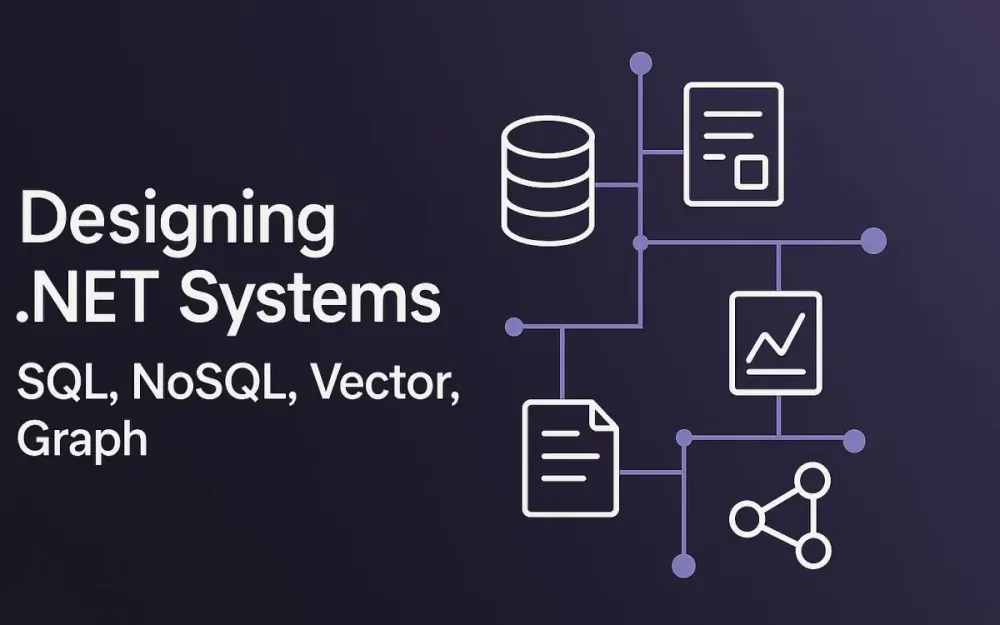
You need to be conversant in SQL, NoSQL, vector, and graph models—and know when each is the right fit.
1.4 What This Article Will Cover
This guide provides a pragmatic, end-to-end view for .NET architects:
- A deep dive into modern database types: Relational, NoSQL, vector, and graph, with .NET-specific insights
- Decision-making frameworks: How to select the right mix for your requirements
- Practical implementation blueprints: Patterns for integrating multiple databases in .NET applications, using modern language and framework features
- Operational realities: Testing, monitoring, DevOps, and cost control
- Real-world examples and code: Using Entity Framework Core 9+, Dapper, MongoDB.Driver, Neo4jClient, and other libraries
2 The Modern Data Toolbox: A Deep Dive for .NET Architects
Let’s examine each class of database and its fit within the modern .NET solution.
2.1 The Workhorse: Relational Databases (SQL)
2.1.1 Core Principles
Relational databases are the most established foundation of business data management. They excel in:
- ACID compliance: Guarantees atomicity, consistency, isolation, and durability. Your data is always correct, even after failures.
- Structured schemas: Data lives in well-defined tables with relationships modeled via foreign keys and constraints.
- Powerful querying: SQL remains the most expressive and widely-used language for joining, filtering, grouping, and aggregating data.
2.1.2 When to Use It
- Transactional systems: Banking, e-commerce, inventory management—whenever data consistency and integrity are non-negotiable
- Systems of record: Anywhere you need a “single source of truth” for key business entities
- Structured data: When your domain is well-understood, and schemas are relatively stable
2.1.3 When to Avoid It
- Unstructured data: If your data is deeply hierarchical, semi-structured, or rapidly evolving, relational tables may become a liability
- Massive horizontal scale-out: Relational databases scale vertically (bigger hardware) more easily than horizontally (more servers), which can be limiting for internet-scale workloads
- Schema rigidity: If your app’s data model changes frequently, or you must store polymorphic documents, a relational schema can slow you down
2.1.4 The .NET Ecosystem: SQL Server, Azure SQL, PostgreSQL, and the Role of Entity Framework Core 9+
In the Microsoft world, relational databases remain first-class citizens. You have a mature toolset:
- SQL Server / Azure SQL: Deep integration with .NET, best-in-class tooling, and robust cloud options
- PostgreSQL: Popular for open-source projects, growing .NET support, and strong compliance with standards
ORM and Data Access: Entity Framework Core 9+
Entity Framework Core 9+ represents the state-of-the-art in .NET ORM tooling. It supports:
- LINQ-based querying
- Migrations and code-first schema management
- Modern language features: e.g.,
async/await, value converters, owned types, and support for new C# record types
Here’s a simple example—imagine modeling a product catalog:
public class Product
{
    public int Id { get; set; }
    public required string Name { get; set; }
    public required decimal Price { get; set; }
    public required string Category { get; set; }
    public DateTime CreatedAt { get; set; }
}

public class CatalogDbContext : DbContext
{
    public DbSet<Product> Products => Set<Product>();

    protected override void OnConfiguring(DbContextOptionsBuilder optionsBuilder)
    {
        optionsBuilder.UseSqlServer("your-connection-string");
    }
}
With EF Core, you can efficiently query, filter, and aggregate data:
// Example: Fetch all products in a category, ordered by price
var products = await dbContext.Products
    .Where(p => p.Category == "Books")
    .OrderBy(p => p.Price)
    .ToListAsync();
Key Takeaways for Architects:
- EF Core now supports bulk operations, temporal tables, and improved concurrency handling
- Database projects can be codified, versioned, and integrated into DevOps pipelines
- SQL remains the best fit when you need strong consistency, referential integrity, and complex analytical queries
Limitations:
- Schema migrations can be painful as domains evolve
- Denormalization and performance tuning require careful design
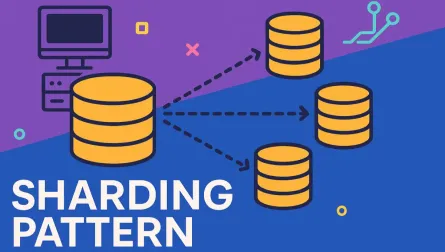
- Scaling out is achievable with sharding and cloud-native features, but it’s still a heavier lift than some NoSQL platforms
2.2 The Scalers: NoSQL Databases
Relational databases earned their keep for decades by excelling at structured, transactional workloads. Yet, they were never built for scale-out internet realities, or the shape-shifting demands of today’s distributed microservices. NoSQL databases arose not out of rebellion, but necessity: new data shapes, velocity, and access patterns. They are now essential elements in any serious .NET architect’s toolkit.
Let’s clarify each category and its practical fit.
2.2.1 Document Databases (e.g., MongoDB, Azure Cosmos DB for NoSQL)
Use Cases
Imagine you’re building a modern e-commerce platform with highly flexible product catalogs. Each product type—books, electronics, apparel—has different attributes and often changes over time. Encoding such heterogeneity in rigid relational tables can quickly become a maintenance nightmare.
Document databases such as MongoDB and Azure Cosmos DB (NoSQL API) embrace this challenge. They store data as documents (typically JSON or BSON), letting each record have its own schema. This flexibility makes them a natural fit for:
- Product catalogs with many optional or evolving fields
- Content management systems
- User profiles and settings
- Storing entire aggregates in a single document (great for event sourcing)
Why is this so aligned with .NET? C# and .NET applications are increasingly object-oriented and JSON-centric. The document model mirrors object graphs, and modern .NET serialization libraries (System.Text.Json, Newtonsoft.Json) make moving data between the database and your app almost seamless.
Example: Modeling a Product Catalog in MongoDB
public class Product
{
    public ObjectId Id { get; set; }
    public required string Name { get; set; }
    public required string Category { get; set; }
    public Dictionary<string, object>? Attributes { get; set; }
}

// Insert a product with flexible attributes
await collection.InsertOneAsync(new Product
{
    Name = "Laptop",
    Category = "Electronics",
    Attributes = new Dictionary<string, object>
    {
        ["RAM"] = "16GB",
        ["Storage"] = "512GB SSD",
        ["GPU"] = "NVIDIA RTX 4060"
    }
});
Notice how the schema bends to each product’s needs—no “ALTER TABLE” required.
Cosmos DB for NoSQL
Azure Cosmos DB, with its NoSQL API, offers globally distributed, fully managed document storage. Unlike MongoDB, it adds multi-region replication and tunable consistency. With the official Azure Cosmos DB SDK for .NET, you get rich integration, LINQ support, and true cloud-scale SLAs.
When Not to Use
Despite the flexibility, document stores are a poor fit when you require complex multi-entity transactions or frequent ad-hoc relational queries. They’re also not ideal for write-heavy, low-latency cache scenarios—that’s where key-value shines.
2.2.2 Key-Value Stores (e.g., Redis, Azure Cache for Redis)
Use Cases
Key-value databases are the answer when you need raw speed and simplicity. They offer a dictionary-like structure, ideal for scenarios where each key maps to a value, and you don’t need relationships or secondary indexes.
Classic use cases include:
- Distributed caching: Store session data, authorization tokens, or precomputed results
- Leaderboards: Gaming platforms track scores by user IDs
- Real-time analytics: Ingest events at high velocity, then aggregate elsewhere
Redis is the standout here, and it’s almost universally used as the default distributed cache for ASP.NET Core apps. With Azure Cache for Redis, you get managed hosting, scaling, and high availability.
Example: Distributed Caching in .NET with Redis
var cache = ConnectionMultiplexer.Connect("localhost");
var db = cache.GetDatabase();

// Store user session
await db.StringSetAsync("session:456", JsonSerializer.Serialize(userSession));

// Retrieve session
var sessionData = await db.StringGetAsync("session:456");
.NET’s IDistributedCache interface abstracts Redis or SQL Server, supporting swap-in configuration.
When Not to Use
Key-value stores are not for relational queries, analytics, or data that needs to persist long-term with structure. If you need even basic filtering or ad hoc search, use another model.
2.2.3 Column-Family Stores (e.g., Apache Cassandra, Azure Cosmos DB for Cassandra)
Use Cases
Column-family stores handle workloads that demand write throughput and horizontal scale—think IoT, telemetry, or analytics streams that need to ingest gigabytes per second and query on time windows.
Apache Cassandra is open-source, designed for fault-tolerance, linear scale-out, and writes that never block reads. Its data model is essentially a multi-dimensional map—rows indexed by a primary key, but each row can have a variable set of columns.
Azure Cosmos DB for Cassandra offers the same API with cloud-native guarantees, making it simple to move or extend on-prem Cassandra workloads to Azure.
Ideal scenarios:
- Time-series data: Billions of sensor events, log lines, or financial ticks
- IoT telemetry: Device state over time
- High write, append-only workloads: Audit logs, activity streams
Example: Logging IoT Events
public class DeviceEvent
{
    public Guid DeviceId { get; set; }
    public DateTime Timestamp { get; set; }
    public string EventType { get; set; }
    public string Data { get; set; }
}
In Cassandra, you’d model the table with a compound primary key (DeviceId, Timestamp), enabling fast range queries by device and time.
When Not to Use
Column-family stores don’t shine for ad hoc queries, multi-table joins, or transactional updates across many keys. They favor denormalization and pre-planned access patterns. Their learning curve is real, and operational complexity (backup, schema evolution, tuning) is higher than most document or key-value stores.
2.2.4 The .NET Ecosystem: Drivers and SDKs
For .NET architects, the real-world viability of NoSQL depends on mature, well-maintained client libraries. Fortunately, the .NET ecosystem is robust:
- MongoDB: MongoDB.Driver
- Azure Cosmos DB: Microsoft.Azure.Cosmos
- Redis: StackExchange.Redis
- Cassandra: DataStax C# Driver
- Cosmos DB Cassandra API: Connect using the Cassandra driver for .NET
These libraries increasingly support async/await, LINQ-style queries, and advanced connection management. Integration with DI containers, logging frameworks, and Azure App Services is first-class, allowing you to embed these data stores naturally into microservice architectures.
Best Practice: Design your app’s data access layer to abstract database operations behind interfaces. This makes it easier to switch drivers, mock data stores for testing, and adopt new APIs without rewriting business logic.
2.3 The Connectors: Graph Databases
As systems grow in complexity, understanding how data entities relate becomes a strategic advantage. Social networks, fraud detection systems, and even supply chain analytics rely not just on the data, but on the relationships between data. Enter the graph database.
2.3.1 Core Principles
Graph databases reimagine data storage around nodes (entities) and edges (relationships), each with properties. This allows for querying relationships, traversing graphs, and analyzing network structures natively.
If you’ve ever written recursive SQL queries to walk a hierarchy, or struggled to model “friends of friends,” a graph database is what you actually wanted.
Common Graph Database Features:
- Nodes (vertices) and edges (connections) can have arbitrary properties
- Native support for traversals, shortest path, and graph algorithms
- Schema-optional: add new types of nodes or edges on the fly
2.3.2 When to Use It
Graph databases are not about data volume, but about connections:
- Social networks: Modeling users, relationships, posts, likes, and shares
- Recommendation engines: “People who bought X also bought Y”
- Fraud detection: Finding suspicious transaction chains, circular dependencies, or collusion
- Network analysis: IT infrastructure, dependency mapping, knowledge graphs
Consider a .NET platform for HR management. Employee records are relational, but org chart queries—“who reports to whom, across several levels?”—are best solved as a graph traversal.
2.3.3 When to Avoid It
If your data model is flat, tabular, or only rarely involves relationships, graph databases add unnecessary complexity. Analytics workloads focused on aggregates (sums, counts) are more efficiently served by columnar or relational stores. In these cases, the cost of introducing a graph database outweighs the benefits.
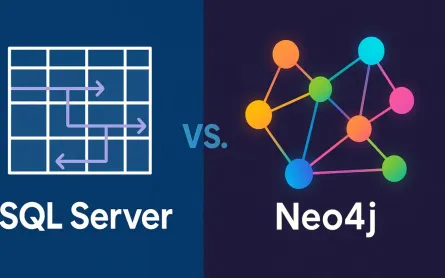
2.3.4 The .NET Ecosystem: Neo4j and Azure Cosmos DB for Gremlin
Neo4j is the leading open-source graph database. It uses the Cypher query language and offers a mature official .NET driver.
Azure Cosmos DB supports the Gremlin graph traversal language via its Gremlin API, allowing you to model and query graphs at cloud scale.
Example: Querying Friends of Friends in Neo4j
var driver = GraphDatabase.Driver("bolt://localhost:7687", AuthTokens.Basic("user", "password"));

using var session = driver.AsyncSession();

var result = await session.RunAsync(
    "MATCH (p:Person {name: $name})-[:FRIENDS_WITH]->(friend)-[:FRIENDS_WITH]->(fof) RETURN fof.name",
    new { name = "Alice" });

await foreach (var record in result)
{
    Console.WriteLine(record["fof.name"]);
}
This example finds “friends of friends” for Alice. The Cypher query is succinct, expressive, and naturally aligns with the domain.
Cosmos DB for Gremlin
With Gremlin.Net, you can run graph traversals directly against Cosmos DB, leveraging the same global distribution and multi-region capabilities as its document store.
Pro Tip: When adding a graph store to your .NET architecture, use it to power features that benefit from deep relationship traversal—recommendations, fraud paths, access control—not to replace your core transactional store.
2.4 The Brains: Vector Databases
AI is rapidly shifting from the hype cycle into practical .NET architectures. At the heart of this transformation are vector databases, purpose-built for storing and querying embeddings—the high-dimensional vectors produced by neural networks.
2.4.1 Core Principles
Unlike traditional databases, which store explicit values (strings, numbers), vector databases store numeric arrays—each representing a document, image, or entity as a point in high-dimensional space. They support approximate nearest neighbor (ANN) searches, finding the “closest” vectors to a query vector in milliseconds, even at scale.
This enables:
- Semantic search: Find relevant results based on meaning, not just keywords
- Recommendations: Suggest similar products or content
- Image/audio search: Find similar media by feature vectors
2.4.2 The Rise of AI and RAG
Why does this matter for .NET architects? Modern applications increasingly leverage AI-powered features:
- Retrieval-Augmented Generation (RAG): Grounding LLMs with enterprise data by retrieving relevant context
- Semantic search: Users expect Google-like search experiences, not just literal keyword matching
- Personalization: Dynamic, user-specific recommendations
Vector databases are the backbone of these capabilities. They let you ingest millions of documents or images, then surface “semantically similar” items in real time.
2.4.3 When to Use It
Consider vector databases when you need to:
- Power AI chatbots that ground responses with private knowledge (RAG)
- Build smart search experiences where intent matters more than exact keywords
- Serve real-time recommendations based on similarity
- Implement security, deduplication, or anomaly detection based on feature vectors
If your data needs revolve around rigid structure, joins, or simple lookups, a vector database is not the right tool.
2.4.4 The .NET Ecosystem: Azure AI Search, Pinecone, Milvus, Qdrant
The .NET community can now tap into a growing array of vector-native solutions, either via cloud APIs or open-source projects.
Azure AI Search
Azure AI Search recently introduced native vector search support, letting you store embeddings (from OpenAI, Azure AI, or Hugging Face) and perform ANN queries as part of your search index.
var searchClient = new SearchClient(
    new Uri("https://<your-service>.search.windows.net"),
    "<index-name>",
    new AzureKeyCredential("<api-key>")
);

// Example: search using an embedding vector
var vector = GetEmbeddingFor("enterprise security platform");
var options = new SearchOptions
{
    Vector = vector,
    VectorFields = { "contentVector" },
    KNearestNeighborsCount = 10
};

var results = searchClient.Search<SearchDocument>("*", options);
Pinecone, Milvus, and Qdrant
These platforms focus entirely on scalable, low-latency vector search. .NET integration is usually via RESTful APIs or OpenAPI-generated clients.
Sample REST Call (Qdrant):
using var client = new HttpClient();
var response = await client.PostAsJsonAsync(
    "https://your-qdrant-instance.com/collections/my_vectors/points/search",
    new
    {
        vector = myEmbedding,
        top = 5
    });
For Milvus and Qdrant, open-source .NET SDKs are emerging, but REST/HTTP remains the primary interface as of mid-2025.
Vector Creation in .NET: You’ll need an embedding model, such as OpenAI’s Ada-002 or Microsoft’s Azure OpenAI, which you can call from .NET using their official SDKs.
// Pseudo-code for generating embeddings with Azure OpenAI
var embedding = await openAiClient.GetEmbeddingsAsync(
    "text-embedding-ada-002",
    new EmbeddingOptions { Input = "Find me similar support tickets" });
Architectural Note: Vector stores rarely stand alone. They’re most powerful as part of a polyglot system—combine them with document stores for metadata, or relational stores for system-of-record needs, orchestrated by your .NET microservices.
3 The Architect’s Decision Framework: A Pragmatic Guide
Polyglot persistence brings undeniable technical power, but it also demands mature, deliberate decision-making. The danger isn’t using the wrong tool, but using every tool at once without a strategy. Here, we’ll focus on frameworks and questions that experienced .NET architects use to tame complexity and design for business value.
3.1 Start with the Domain: DDD and Bounded Contexts
Before you debate SQL vs. NoSQL, the first question is: What is the shape and boundary of your data?
Domain-Driven Design (DDD) teaches that complex business systems should be broken down into bounded contexts—distinct spheres of the domain with their own language, rules, and models. Each context often aligns naturally to a different data model.
For example:
- User Management: ACID transactions, strong consistency, and referential integrity—perfect for a relational store.
- Product Catalog: Rapidly evolving schemas, varying attributes—ideally suited for a document database.
- Recommendation Engine: Rich relationships, graph traversals—graph database is the best fit.
.NET Implementation Tip: Architect each bounded context as an autonomous service with its own database. Resist the temptation to share databases between contexts. This decouples evolution and scaling, and empowers teams to choose the right database per context.
3.2 Deconstruct Your Data Needs: The Four V’s in Practice
You can’t architect what you haven’t measured or understood. The Four V’s provide a reality check for database selection.
3.2.1 Volume
How much data will your system handle—now and in five years? Is your storage need measured in gigabytes, terabytes, or petabytes? Do you anticipate archiving or frequent purging, or will data accumulate indefinitely?
- Relational and document databases are comfortable with large but finite datasets (GBs to TBs).
- Column-family and distributed NoSQL databases (like Cassandra) excel when scaling to petabytes.
3.2.2 Velocity
What are your expected read and write rates? Are you ingesting 10 writes per second or 10,000? Are spikes predictable (e.g., Black Friday) or random?
- Key-value and column-family stores shine for ultra-high write throughput.
- Redis is invaluable for low-latency reads and high-concurrency scenarios.
- Relational DBs can become bottlenecks at very high scale, unless you implement sharding or advanced partitioning.
3.2.3 Variety
How diverse is your data? Does every record look the same, or are you dealing with polymorphic, ever-changing entities?
- Document databases excel at variety; their schema-on-read nature makes them agile.
- Relational DBs demand a well-defined schema, which can slow iteration.
- Graph and vector databases support specialized varieties—rich relationships and high-dimensional data.
3.2.4 Veracity
What are your requirements around correctness, consistency, and trust? Is it acceptable for a user to see slightly stale data, or is absolute consistency non-negotiable?
- Relational databases are the gold standard for transactional integrity.
- NoSQL and distributed stores often offer tunable consistency—eventual, bounded staleness, or strong consistency at the expense of latency.
- Graph and vector stores may offer best-effort or eventual consistency, especially at global scale.
Action Point: Map each microservice’s core requirements to the Four V’s. Document your assumptions. This brings clarity to discussions with business and product stakeholders, and guides technology selection with evidence.
3.3 The CAP Theorem in a Polyglot World
The CAP theorem says you can only guarantee two out of three: Consistency, Availability, Partition Tolerance. In a distributed, polyglot system, the trade-offs are even sharper. Each service can (and should) make an explicit choice based on its business needs.
- Consistency: Every read gets the latest write, but network partitions may block progress. Choose for orders, payments, or inventory.
- Availability: The system always responds, but data may be stale during partitions. Good for user feeds or search.
- Partition Tolerance: The system continues to operate despite network failures. Unavoidable in distributed cloud systems.
Real-World Tip: Don’t seek a one-size-fits-all answer. For .NET microservices, use the CAP lens at the service level, not the platform level. Example: Your cart service may favor availability (customers can always check out), while your payment service must favor consistency (no double-billing).
3.4 Query Patterns vs. Write Patterns
A trap for architects is designing a schema based solely on how data is written. High-performing systems begin with query patterns—what are the most common, expensive, or business-critical reads?
- If you need real-time analytics across vast logs, choose columnar or time-series stores.
- If your queries follow relationship chains (“customers who bought X also bought Y”), graph databases are optimal.
- If you serve high-cardinality lookups (“what are all the orders for this customer?”), choose indexes and data partitioning accordingly.
Key Principle: Design your data models around how data is consumed, not just how it is produced.
3.5 Creating a “Data Decision Matrix”
Architects use decision matrices to make complex trade-offs explicit and transparent. For each data domain, build a simple matrix like:
| Data Domain | Volume | Velocity | Variety | Veracity | Query Pattern | Best Fit Store |
|---|---|---|---|---|---|---|
| Orders | High | Medium | Low | Strong | Write/read by ID, reports | SQL Server |
| Product Catalog | Medium | High | High | Eventual | Flexible, search/filter | Cosmos DB (Doc) |
| Session Cache | Medium | High | Low | Eventual | Get/set by key | Redis |
| Recommendations | Low | Medium | High | Eventual | Multi-hop relationships | Neo4j |
| Image Similarity | High | Medium | Medium | Eventual | Vector nearest neighbor | Azure AI Search |
This matrix is your north star—justify each choice in context, and revisit as requirements evolve.
4 Implementation Blueprints: Polyglot Persistence in a .NET 9+ World
Theory matters, but successful architectures are measured in working code, uptime, and maintainability. Let’s look at modern .NET implementation blueprints—patterns, code, and operational strategies that turn polyglot designs into resilient, maintainable reality.
4.1 Core Pattern: Database-per-Microservice
4.1.1 Data Sovereignty and Decentralized Governance
Each microservice owns its data store, schema, and access methods. This enables true independence—teams can iterate, scale, and deploy without stepping on each other’s toes. There’s no central DBA bottleneck, and database choices can evolve per service.
- No shared database logins or tables
- No “god” schema trying to fit every use case
- Database backups, migrations, and scaling are service-level concerns
4.1.2 Example: Users in SQL, Products in Document DB
Users Service (Relational DB, EF Core):
public class User
{
    public int Id { get; set; }
    public required string Email { get; set; }
    public required string PasswordHash { get; set; }
    public DateTime RegisteredAt { get; set; }
}

public class UsersDbContext : DbContext
{
    public DbSet<User> Users => Set<User>();
    // OnConfiguring, etc.
}
Products Service (Document DB, MongoDB):
public class Product
{
    public ObjectId Id { get; set; }
    public required string Name { get; set; }
    public required string Category { get; set; }
    public Dictionary<string, object>? Attributes { get; set; }
}

var products = database.GetCollection<Product>("products");
await products.InsertOneAsync(new Product { /* ... */ });
Each service manages migrations, schema changes, and indexes independently, reducing the risk of global outages or deployment conflicts.
4.2 Advanced Pattern: CQRS (Command Query Responsibility Segregation)
4.2.1 Write vs. Read Models
CQRS separates write (command) and read (query) models. This enables:
- Highly normalized, ACID-compliant writes for business logic
- Denormalized, query-optimized read models for performance
4.2.2 .NET Implementation: Write in SQL, Read from NoSQL
Write model: Handled by EF Core, saving to a normalized SQL Server database.
Read model: Populated asynchronously by a background service that listens to domain events (e.g., via message broker), then writes precomputed views to Redis or Cosmos DB for ultra-fast reads.
Sample Write Code:
// Command handler in Users Service
dbContext.Users.Add(newUser);
await dbContext.SaveChangesAsync();
// Publish UserCreated event to message broker
Sample Read Population:
// Background worker consumes UserCreated event
var userProfile = new UserProfileDocument { /* ... */ };
await cosmosDbCollection.InsertOneAsync(userProfile);
Read API:
// Fast lookup by user ID from Cosmos DB
var profile = await cosmosDbCollection.Find(x => x.UserId == id).FirstOrDefaultAsync();
This separation enables each model to be optimized for its core workload, improving both write integrity and read performance.
4.3 Advanced Pattern: Event Sourcing
4.3.1 The Event Log as the Source of Truth
Event sourcing records every state change as an immutable event in an append-only log. The current state is reconstructed by replaying these events.
Benefits:
- Full audit trail of all actions
- Easy to build projections for new query patterns
- Natural fit for distributed, event-driven architectures
4.3.2 .NET Implementation: Event Store, Message Broker, and Projections
Event Store: Use a message broker such as Azure Service Bus or RabbitMQ as the core event log, or adopt a purpose-built event store like EventStoreDB.
Consumer Projections: Multiple microservices consume events and build their own projections—saving data to SQL, MongoDB, Neo4j, etc.
Event Publishing Example:
// When an order is placed, publish an event
await serviceBusSender.SendMessageAsync(
    new ServiceBusMessage(JsonSerializer.Serialize(new OrderPlacedEvent { /* ... */ })));
Projection Example:
// Consumer receives OrderPlacedEvent, updates read model
await mongoDbCollection.InsertOneAsync(new OrderReadModel { /* ... */ });
Tip: Event sourcing introduces complexity in schema evolution, versioning, and eventual consistency. Use it when you need traceability and replay, not as a default for every service.
4.4 Real-World Scenario: Building a Modern .NET E-commerce Platform
Bringing these patterns together, let’s sketch a realistic e-commerce architecture, combining multiple data stores for optimal performance and flexibility.
4.4.1 User & Order Service: SQL Server for ACID Transactions
- Why: User accounts and orders demand strong consistency, referential integrity, and transactional guarantees.
- .NET Pattern: Use EF Core 9+ for data access, migrations, and domain logic.
public class Order
{
    public int Id { get; set; }
    public int UserId { get; set; }
    public required DateTime OrderedAt { get; set; }
    public List<OrderItem> Items { get; set; } = [];
    public required decimal Total { get; set; }
}
4.4.2 Product Catalog Service: Cosmos DB for Schema Flexibility
- Why: Product schemas evolve rapidly, with new categories and attributes.
- .NET Pattern: Use Azure Cosmos DB SDK, store product metadata as flexible documents.
public class ProductDocument
{
    [JsonPropertyName("id")]
    public string Id { get; set; }
    public required string Name { get; set; }
    public required string Category { get; set; }
    public Dictionary<string, object> Attributes { get; set; }
}
4.4.3 Inventory & Caching Service: Redis
- Why: Stock levels and inventory data require ultra-fast updates and reads, especially during sales events.
- .NET Pattern: Use StackExchange.Redis, store stock counts as keys.
// Set inventory count
await redisDb.StringSetAsync("inventory:sku123", 42);
// Get inventory count
var stock = await redisDb.StringGetAsync("inventory:sku123");
4.4.4 “Customers Also Bought” Service: Graph Database
- Why: To recommend products based on real purchase paths and co-occurrence patterns.
- .NET Pattern: Use Neo4j’s .NET driver, model purchases and customer-product relationships as a graph.
var query = @"
    MATCH (u:User)-[:BOUGHT]->(p:Product)
    WHERE u.id = $userId
    MATCH (p)<-[:BOUGHT]-(otherUser)-[:BOUGHT]->(otherProduct:Product)
    RETURN otherProduct.name, count(*) as score
    ORDER BY score DESC
    LIMIT 5";
4.4.5 “Search by Image” Feature: Vector Database
- Why: Users upload a photo, and the system finds visually similar products—impossible with keywords.
- .NET Pattern: Use Azure AI Search with vector support; store image embeddings and query by vector similarity.
var embedding = await openAiClient.GetEmbeddingsAsync("image-embedding", new EmbeddingOptions { /* ... */ });

var searchOptions = new SearchOptions
{
    Vector = embedding,
    VectorFields = { "imageVector" },
    KNearestNeighborsCount = 10
};

var results = searchClient.Search<Product>("*", searchOptions);
4.4.6 .NET Code Snippets: Connecting to Each Store
SQL Server / EF Core:
using var dbContext = new ECommerceDbContext();
await dbContext.Orders.AddAsync(order);
await dbContext.SaveChangesAsync();
Cosmos DB:
var cosmosClient = new CosmosClient("<connection-string>");
var productsContainer = cosmosClient.GetContainer("ecom", "products");
await productsContainer.UpsertItemAsync(product);
Redis:
var redis = ConnectionMultiplexer.Connect("<redis-connection-string>");
var db = redis.GetDatabase();
await db.StringSetAsync("inventory:sku123", 42);
Neo4j:
var driver = GraphDatabase.Driver("bolt://localhost:7687", AuthTokens.Basic("user", "password"));
using var session = driver.AsyncSession();
var result = await session.RunAsync(query, new { userId = 1 });
Azure AI Search (Vector):
var searchClient = new SearchClient(new Uri("<endpoint>"), "<index>", new AzureKeyCredential("<key>"));
var options = new SearchOptions { Vector = embedding, KNearestNeighborsCount = 10, VectorFields = { "imageVector" } };
var products = searchClient.Search<Product>("*", options);
Operational Best Practices:
- Automate provisioning and scaling for each data store using infrastructure-as-code (e.g., Bicep, Terraform, Azure ARM templates).
- Integrate health checks and telemetry for each database connection.
- Secure connection strings and credentials using Azure Key Vault or similar secrets management tools.
- Monitor performance and set up alerts for latency, error rates, and resource usage per store.
- Run load tests reflecting real-world polyglot workloads—not just isolated unit tests.
5 Navigating the Labyrinth: Operational Challenges and Solutions
Architectural diagrams are tidy; real-world operations rarely are. With every new database comes new responsibilities, skill sets, and trade-offs. Polyglot persistence is not a set-and-forget decision—it is an ongoing commitment to management, resilience, and improvement. This section addresses the most pressing operational challenges, paired with practical mitigation strategies.
5.1 The Data Consistency Conundrum: Embracing Eventual Consistency
Distributed systems force architects to acknowledge the limits of perfect consistency. Once data leaves the boundaries of a single transactional database, eventual consistency is no longer a choice—it’s a reality.
What Does This Mean in Practice?
In a polyglot system, different data stores might not be synchronized at all times. For example, when an order is placed:
- The Orders service (SQL Server) records the transaction immediately.
- The Inventory service (Redis) might not reflect the reduced stock for a few seconds.
- The Recommendation engine (Neo4j) may not “see” the new purchase until the event propagates.
This is not a bug, but a feature of a system designed for scale, resilience, and performance.
How to Embrace Eventual Consistency
- Design for Idempotency: Ensure that processing the same message or event multiple times does not corrupt state.
- Inform Users: Communicate potential delays in data propagation, e.g., “Your order may take a few moments to appear.”
- Leverage Outbox and Inbox Patterns: Store outgoing messages with transactional changes to guarantee that events are only published after a successful database commit.
- Graceful Degradation: Architect the UI to gracefully handle temporary inconsistencies.
.NET Example: Outbox Pattern with EF Core
public class Order
{
    public int Id { get; set; }
    // Other properties
    public List<OutboxMessage> OutboxMessages { get; set; } = [];
}

public class OutboxMessage
{
    public int Id { get; set; }
    public string EventType { get; set; }
    public string Payload { get; set; }
    public DateTime OccurredAt { get; set; }
}

// Transactionally save order and event
dbContext.Orders.Add(order);
dbContext.OutboxMessages.Add(new OutboxMessage { /* ... */ });
await dbContext.SaveChangesAsync();
A background worker reliably publishes Outbox events, ensuring at-least-once delivery and consistency between state and events.
5.2 The Saga Pattern: Managing Distributed Transactions Across Services in .NET
When a business process spans multiple services (and therefore multiple databases), traditional transactions aren’t enough. The Saga pattern provides a way to manage long-running, distributed workflows by breaking them into a series of local transactions, each with a compensating action in case of failure.
How Sagas Work
- Each step completes a local transaction and triggers the next step via messaging.
- If a step fails, the saga executes compensating actions to roll back previous steps.
- Sagas are orchestrated either centrally (with a workflow engine) or choreographically (with services reacting to each other’s events).
.NET Implementation: MassTransit Sagas
MassTransit offers robust saga support for .NET, integrating with message brokers and supporting state persistence.
public class OrderSaga : MassTransitStateMachine<OrderState>
{
    public OrderSaga()
    {
        InstanceState(x => x.CurrentState);

        Event(() => OrderSubmitted, x => x.CorrelateById(context => context.Message.OrderId));
        Event(() => PaymentProcessed, x => x.CorrelateById(context => context.Message.OrderId));

        Initially(
            When(OrderSubmitted)
                .Then(context => { /* Start order */ })
                .TransitionTo(Submitted)
                .Publish(context => new ProcessPayment(context.Instance.CorrelationId))
        );

        During(Submitted,
            When(PaymentProcessed)
                .Then(context => { /* Complete order */ })
                .TransitionTo(Completed));
    }

    public State Submitted { get; private set; }
    public State Completed { get; private set; }
    public Event<OrderSubmitted> OrderSubmitted { get; private set; }
    public Event<PaymentProcessed> PaymentProcessed { get; private set; }
}
When to Use Sagas
- Multi-step, cross-database workflows (e.g., order placement, payment, shipping)
- Scenarios where compensating transactions are clearly defined
Key Lessons
- Keep saga logic explicit and auditable.
- Design compensating actions carefully—they should genuinely undo previous steps where possible.
- Monitor saga state and failures; provide visibility in dashboards.
5.3 Unified Observability: Centralized Logging, Metrics, and Tracing
Polyglot architectures make troubleshooting much harder. Errors may not be obvious: a query slows down in MongoDB, but symptoms appear in the API layer. Unified observability is no longer a “nice to have”—it’s essential.
Key Practices
- Centralized Logging: Aggregate logs from all microservices and databases into a centralized platform (e.g., Azure Monitor, Elastic Stack, or Grafana Loki).
- Distributed Tracing: Use tracing (OpenTelemetry, Application Insights) to follow a request across services, including time spent in each database.
- Metrics and Alerts: Collect and monitor key metrics—query latency, throughput, error rates—for every data store.
- Dashboards and Alerts: Build dashboards that correlate events and trigger alerts on anomalies.
.NET Implementation: OpenTelemetry Example
using OpenTelemetry.Trace;

var builder = WebApplication.CreateBuilder(args);
builder.Services.AddOpenTelemetry()
    .WithTracing(tracing =>
    {
        tracing.AddAspNetCoreInstrumentation();
        tracing.AddSqlClientInstrumentation();
        tracing.AddRedisInstrumentation();
        // Add more as needed
    })
    .AddOtlpExporter(); // Export to centralized collector
Practical Advice: Instrument each database connection and query. Use structured logging to include correlation IDs and trace context, making cross-service analysis possible.
5.4 The Tooling Tax: Managing a Heterogeneous Environment
With multiple databases come multiple operational concerns—each one requiring specialized tooling for:
- Backups and restores: Automate and validate backup processes for each database type.
- Schema migration: Use automated, version-controlled migrations (e.g., EF Core Migrations, Liquibase for SQL; custom scripts for NoSQL).
- Security and access management: Enforce least privilege, rotate secrets, and audit access across all stores.
- Updates and patching: Monitor for vulnerabilities and keep all database servers and clients up to date.
How to Manage the Tax
- Standardize on IaC: Provision all databases using infrastructure-as-code (Bicep, Terraform, ARM templates).
- Centralize Secrets: Store all credentials in a centralized vault (e.g., Azure Key Vault), never in code or config files.
- Automate Everything: Use CI/CD to deploy, test, and roll back database changes.
- Document Procedures: Maintain clear runbooks for disaster recovery, failover, and troubleshooting for every data technology.
Example: Automating Cosmos DB with Bicep
resource cosmosDb 'Microsoft.DocumentDB/databaseAccounts@2023-04-15' = {
  name: 'my-cosmos-account'
  location: resourceGroup().location
  kind: 'GlobalDocumentDB'
  properties: {
    // Configuration here
  }
}
Automated provisioning and policy enforcement keep your growing database estate manageable.
5.5 The Human Factor: Upskilling the Development Team
Polyglot persistence raises the bar for your engineering organization. Developers, DevOps, and architects all need to learn new paradigms, query languages, failure modes, and operational best practices.
Avoiding Cognitive Overload
- Invest in Training: Budget time and resources for workshops, pairing, and cross-training in MongoDB, Neo4j, Redis, etc.
- Establish Patterns: Provide code templates, shared libraries, and best practices to reduce decision fatigue.
- Mentoring and Documentation: Senior architects should mentor teams, and high-quality internal docs should cover database usage patterns, anti-patterns, and operational guides.
- Limit Technology Proliferation: Don’t use every database under the sun. Select a “preferred” stack per problem space and revisit choices only with strong justification.
Example: Knowledge Sharing
Regularly schedule architectural review sessions where teams demo successes and failures from production. Encourage a culture of learning from incidents, not hiding them.
6 The Horizon: The Future of Data in .NET Applications
Polyglot persistence is still evolving. The trends shaping its future will further alter how .NET architects design, deploy, and manage data-driven systems.
6.1 The Convergence: Multi-Model Databases
Vendors are responding to polyglot complexity by introducing multi-model databases—platforms capable of serving multiple data models from a single engine.
- Cosmos DB supports document, key-value, column-family, and graph APIs under one SLA and security model.
- ArangoDB, OrientDB, and similar solutions offer graph, document, and key-value capabilities natively.
Benefits
- Simplifies deployment and operations—fewer moving parts.
- Enables reuse of operational patterns (backups, security, scaling).
- Accelerates prototyping and evolution.
Caveats
- Multi-model often means “jack of all trades, master of none.” Deep specialization still favors dedicated engines for demanding workloads.
6.2 The Abstraction Layer: Synapse Analytics, Data Fabrics, and Beyond
Complexity in accessing heterogeneous data sources has led to the rise of data fabrics and integration platforms.
- Azure Synapse Analytics provides unified access and analysis across SQL, Spark, Cosmos DB, and external data lakes.
- Data virtualization platforms let you query across databases using a single interface.
Implications for .NET Architects
- Application logic can access diverse data sources through a unified API, reducing the need for custom data-access logic per database.
- Data movement and transformation can be centralized, but be wary of performance bottlenecks and operational complexity.
6.3 AI Inside the Database
The next wave of database evolution is internalized intelligence—databases that support machine learning, inference, and analytics as first-class citizens.
- SQL Server ML Services and PostgreSQL extensions allow running R, Python, or ONNX models inside the database.
- Vector databases natively support similarity search, semantic ranking, and even limited generative AI tasks within queries.
- AI-augmented query planners optimize execution paths using reinforcement learning.
What to Watch For
- Reduced data movement: Training and inference can happen where the data lives.
- More intelligent, adaptive indexes and caching.
- Pushdown of business logic and scoring, reducing latency and architectural complexity.
6.4 The Serverless Data Tier
As compute has moved serverless, so too will data. Serverless databases auto-scale, handle failover, and charge per operation—not per provisioned hardware.
- Azure Cosmos DB serverless, Amazon Aurora Serverless, Azure SQL Hyperscale offer true pay-per-use and near-zero maintenance.
- Serverless fits unpredictable workloads, rapid prototyping, and event-driven architectures.
Implications
- Lower operational burden and cost for variable workloads.
- Instant scale-up and scale-down; less overprovisioning.
- Potential cold-start and latency trade-offs—monitor closely.
7 Conclusion: The Architect as a Polyglot Strategist
The road from monolithic, one-size-fits-all databases to a strategic, polyglot data architecture is both challenging and rewarding. As a .NET solution architect, your role is not simply to choose technologies, but to engineer clarity from complexity—aligning the right tool to each business challenge.
7.1 Key Principles Recap
- Start with the domain. Use DDD and bounded contexts to segment responsibility and data ownership.
- Map requirements to the Four V’s. Let volume, velocity, variety, and veracity guide database selection.
- Accept trade-offs. Use the CAP theorem and query/write patterns to make explicit, transparent choices.
- Model for the query. Optimize data models for how data is consumed, not just how it’s written.
- Design for resilience. Embrace eventual consistency, the saga pattern, and unified observability.
- Prioritize the human factor. Invest in your team’s knowledge, keep operational complexity manageable, and foster a culture of shared learning.
7.2 Final Checklist for Polyglot Architects
- Have you mapped bounded contexts and chosen the right database for each?
- Is each microservice the sole owner of its data store?
- Are you leveraging modern .NET features (async, dependency injection, observability) in your data access layer?
- Do you have robust CI/CD and IaC for every database?
- Is your logging, metrics, and tracing unified across all data stores?
- Have you documented failure modes and compensation actions for distributed workflows?
- Are operational and cognitive loads manageable for your team?
- Is your system ready for scale, change, and new data models as business needs evolve?
7.3 Closing Thoughts: Beyond Complexity for Its Own Sake
Polyglot persistence is not about collecting databases or chasing hype. It’s about recognizing that in a distributed, cloud-native, and AI-augmented world, no single data model suffices. The future belongs to architectures that embrace diversity—not for the sake of novelty, but for the sake of business agility, resilience, and innovation.
By anchoring your choices in domain needs, clear requirements, and proven architectural patterns, you equip your organization not just to keep up with change, but to drive it. Polyglot persistence is the modern baseline for robust, intelligent, and future-proof .NET solutions.
As you architect the next generation of distributed systems, let data strategy be your differentiator—and let pragmatic, polyglot choices empower your engineering teams to deliver more than ever before.