1 Introduction: The New Architectural Imperative
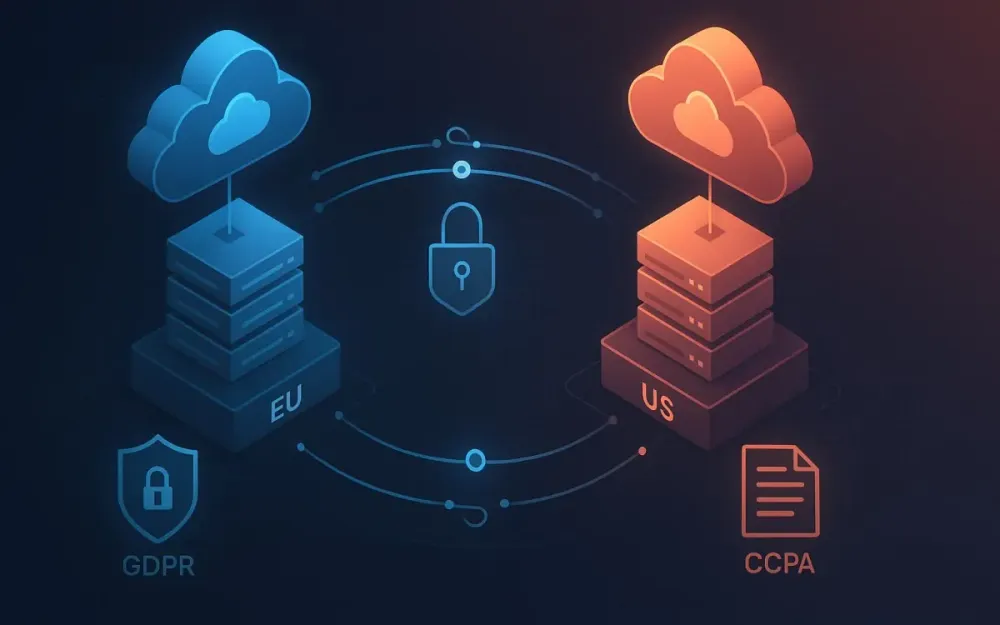
In the last decade, distributed systems have evolved from niche architecture choices into the de facto foundation for enterprise-scale platforms. Microservices, event-driven pipelines, globally distributed databases, and multi-cloud deployments now dominate the blueprint of modern systems. But with that growth comes a shift in the architect’s priorities: compliance is no longer a late-stage legal review; it’s a first-class architectural concern. The laws that govern how, where, and why we process personal data—such as the GDPR, CCPA/CPRA, and emerging data sovereignty rules—are rewriting technical roadmaps. These regulations are not “paper-only” policies; they have concrete implications for how APIs are designed, where data physically resides, and how distributed services interact. The question every senior architect faces is no longer “can we build it?” but “can we build it while staying compliant globally—without killing agility?” This guide starts with the why, moves through the what, and lands squarely in the how—so you can design distributed systems that don’t just survive regulatory scrutiny but thrive under it.
1.1 Beyond the Buzzwords: Why compliance is no longer just a legal checkbox but a core architectural driver
Not long ago, compliance was seen as an afterthought. A team would build a product, deploy it, and then run it past legal for a final “OK.” That approach is not just outdated—it’s operationally dangerous. Modern regulations are broad, enforceable across borders, and carry real teeth: multimillion-euro fines, personal liability for executives, and reputational damage that erodes user trust overnight. More importantly, compliance now intersects directly with technical feasibility. For example:
- A cloud architecture that centralizes global user data in one region may violate data residency laws.
- An event-sourcing system that never deletes historical events may fail “right to erasure” requirements.
- A global logging service that captures PII in plaintext can breach data minimization principles. The cost of bolting on fixes after the fact—rewriting schemas, rearchitecting data flows, splitting infrastructure by region—can exceed the cost of the original build. That’s why “privacy by design” isn’t just a compliance slogan—it’s an architectural survival strategy.
Pro Tip: Treat compliance constraints as non-functional requirements (NFRs) at the same level as performance and availability. They shape architecture early, not late.
1.2 The “Big Three”: A concise overview of the key regulations
While dozens of privacy laws exist worldwide, three concepts dominate current architectural discussions: GDPR, CCPA/CPRA, and Data Sovereignty.
1.2.1 GDPR (General Data Protection Regulation)
The GDPR, enforced since May 2018, is the European Union’s gold-standard privacy law. Its scope is intentionally global: if you process personal data of EU residents, you must comply—regardless of your headquarters’ location. Key principles include:
- Lawfulness, fairness, and transparency: You must have a valid legal basis (e.g., consent, legitimate interest) for processing personal data, and you must clearly communicate what you’re doing.
- Purpose limitation: Data can only be collected for specified, explicit purposes—and not repurposed later without consent.
- Data minimization: Collect only what’s necessary for the purpose stated.
- Accuracy: Keep personal data accurate and up to date.
- Storage limitation: Keep personal data only as long as needed for the stated purpose.
- Integrity and confidentiality: Secure personal data against unauthorized or unlawful processing and against accidental loss.
- Accountability: Be able to demonstrate compliance with all of the above. Rights of data subjects under GDPR include:
- The right to access (what data you hold about them).
- The right to rectification (correction).
- The right to erasure (“right to be forgotten”).
- The right to restrict processing.
- The right to data portability.
- The right to object to processing.
Note: GDPR fines can reach up to €20M or 4% of global annual turnover—whichever is higher.
1.2.2 CCPA/CPRA (California Consumer Privacy Act / California Privacy Rights Act)
The CCPA, in effect since 2020, and its 2023 amendment, the CPRA, focus on giving California residents transparency and control over their personal data. While narrower than GDPR in scope, it is the most influential U.S. privacy regulation. Key features:
- Consumer rights: Access, deletion, and opt-out from the “sale” of personal data.
- Broad definition of “sale”: Includes many forms of data sharing for commercial benefit—not just literal sales.
- Sensitive personal information category (CPRA): Includes government IDs, geolocation, financial information, etc.
- Right to correction (CPRA addition): Consumers can request inaccurate information be corrected.
- Expanded coverage: CPRA created the California Privacy Protection Agency (CPPA) for enforcement.
Architecturally, CCPA/CPRA impacts:
- How data-sharing integrations are designed (especially with third-party analytics/ad networks).
- How opt-out signals are propagated through distributed services.
- How “Do Not Sell or Share My Personal Information” is enforced at the API and database level.
Pitfall: Many teams misinterpret “sale” narrowly and end up non-compliant due to analytics SDKs or marketing integrations that qualify as sharing.
1.2.3 Data Sovereignty and Residency
Data sovereignty means that data is subject to the laws of the country where it’s stored. Data residency is the requirement that data must remain within certain geographic boundaries. This is no longer just an EU issue. Other notable regulations include:
- Brazil’s LGPD: Largely modeled after GDPR, but with local-specific nuances.
- India’s DPDP Act: Introduces consent-centric processing and restrictions on cross-border transfers.
- China’s PIPL: Highly restrictive cross-border transfer rules and strict consent requirements.
- Canada’s PIPEDA: Covers federal-level privacy rights with some province-specific enhancements.
- Australia’s Privacy Act: Includes recent amendments strengthening data breach notification.
For architects, sovereignty and residency rules impact:
- Cloud region selection and multi-region failover design.
- Database replication strategies.
- Backup and disaster recovery planning.
- Vendor and SaaS provider selection.
Trade-off: Strong residency compliance often means duplicating infrastructure per jurisdiction—raising operational costs but reducing legal exposure.
1.3 The Architect’s Dilemma
The tension is clear: regulations are written in broad, human language, while distributed systems operate in precise, machine-level terms. Laws demand guarantees (“data shall not leave the EU”), but systems are built on probabilistic events, eventual consistency, and ephemeral compute nodes that may span borders without notice. Compounding the problem:
- Cloud opacity: Public cloud services may shift underlying resources between zones.
- Shared services: Logging, analytics, and monitoring systems often aggregate data globally.
- Integration sprawl: APIs and event streams send PII into dozens of microservices and third-party platforms.
- Data duplication: Backups, caches, and data lakes hold copies far beyond the “primary” dataset. The result: ensuring compliance is not just about writing the right policy—it’s about rethinking how data is architected into the system.
Pro Tip: Start treating data location, retention, and access as architectural primitives—first-class citizens alongside throughput, latency, and availability.
1.4 Article Roadmap
This article walks you through the process of embedding compliance into your architecture from the ground up:
- Core Principles: Understanding privacy by design, data minimization, and purpose limitation as technical drivers.
- Data Residency Patterns: How to design distributed systems that enforce where data lives.
- Deletion Strategies: Implementing the right to erasure in a world of microservices and immutable logs.
- Audit Logging: Designing immutable, context-rich audit trails.
- Advanced Patterns: Tokenization, anonymization, consent-as-a-service, and cross-border data enforcement.
- Reference Architecture: A concrete example for a multinational e-commerce platform.
- Future-Proofing: Preparing for AI, PETs, digital identity, and regulatory fragmentation.
- The Compliant Architect’s Manifesto: Key takeaways to turn compliance into a competitive advantage.
By the end, you’ll have both the conceptual clarity and the practical blueprints to design systems that meet global compliance requirements without sacrificing scalability or agility.
2 Core Architectural Principles for Compliance
Architecting for GDPR, CCPA, and data sovereignty is less about memorizing legal clauses and more about operationalizing principles into system behavior. The following concepts are not abstract ideals—they are tangible constraints and enablers that shape data flows, service boundaries, and deployment topologies. Each principle described here can be mapped to specific architectural choices that either prevent compliance risks or make demonstrating compliance far easier. By embedding them from day one, you avoid the high cost of retrofitting privacy controls into production systems.
2.1 Privacy by Design & by Default: Shifting left
The “Privacy by Design” concept predates GDPR but was codified by it. The shift-left mindset means you don’t wait for legal review at the end—you design privacy into your system from the first architecture diagram. This approach directly impacts service boundaries, storage formats, integration contracts, and even error logging.
2.1.1 The 7 Foundational Principles
The seven principles of Privacy by Design (PbD) can be translated into engineering terms:
- Proactive, not reactive; preventive, not remedial Build controls that prevent breaches and misuse, rather than detect them after damage occurs. Example: automatically mask PII in logs before they leave the service boundary.
- Privacy as the default setting Opt-in, not opt-out. Default all user preferences to the most privacy-preserving state unless explicitly changed by the user.
- Privacy embedded into design Treat privacy requirements as architectural constraints, just like latency or availability.
- Full functionality—positive-sum, not zero-sum Avoid false trade-offs where possible. For instance, you can still run analytics using anonymized aggregates without exposing raw personal data.
- End-to-end security—full lifecycle protection Protect data from the moment it’s collected to the moment it’s deleted, including backups and archival storage.
- Visibility and transparency Make data flows inspectable and auditable—not just internally, but in ways you can explain to regulators and customers.
- Respect for user privacy—keep it user-centric Build controls that respect the user’s time and mental load. For example, make opt-out and deletion workflows easy to find and execute.
Pro Tip: When writing RFCs for new services, add a “Privacy Impact” section alongside performance, security, and scaling considerations.
2.1.2 Translating Principles into Architectural Decisions
The jump from principle to architecture is where many teams stumble. Here’s how these principles map to concrete design choices:
- UI/UX defaults: For a newsletter sign-up box, pre-checking “Subscribe to marketing emails” violates privacy-by-default. Instead, leave it unchecked and explain the benefits clearly.
- Logging systems: If a customer updates their address, only log the action, not the address itself.
- Service decomposition: Keep high-risk PII-processing components small, isolated, and behind well-audited APIs.
- Data contracts: Define API response schemas that exclude PII by default, requiring explicit opt-in for fields containing personal data.
Example of incorrect vs correct default behavior in a web form:
Incorrect
<label>
  <input type="checkbox" name="subscribe" checked>
  Subscribe to marketing emails
</label>
Correct
<label>
  <input type="checkbox" name="subscribe">
  Subscribe to marketing emails
</label>Pitfall: Many frameworks come with logging and telemetry enabled at high verbosity by default. These logs may capture sensitive data unless explicitly masked or disabled.
2.2 Data Minimization: The “collect only what you need” principle
Data minimization reduces both compliance risk and breach impact. It’s a straightforward concept—don’t collect more personal data than necessary—but implementing it in a distributed architecture requires discipline at multiple layers.
2.2.1 Architectural Impact
Minimization changes how you approach:
- API design: Avoid creating generic “return all user info” endpoints.
- Database schema: Only store columns you actively use; drop unused historical fields.
- Event payloads: Strip PII from messages before publishing to message queues or event streams.
- Third-party integrations: Send only the fields the vendor requires to deliver their service.
Example: A payments microservice likely needs a billing address for fraud checks, but your analytics service does not. Strip that address before sending events to analytics.
Trade-off: Over-aggressive minimization can create usability or feature limitations. Balance minimal collection with legitimate operational needs.
2.2.2 Practical Example: Designing a user registration service
A common anti-pattern is the “kitchen sink” registration form that collects more than is necessary for account creation. Let’s consider two versions of an API contract.
Incorrect
POST /register
{
  "fullName": "John Doe",
  "email": "john@example.com",
  "phone": "+1-202-555-0191",
  "dateOfBirth": "1985-03-12",
  "address": {
    "street": "123 Elm Street",
    "city": "Springfield",
    "state": "CA",
    "postalCode": "90001"
  },
  "gender": "male"
}
Correct
POST /register
{
  "email": "john@example.com",
  "password": "S3cureP@ss!"
}
Later, if a specific feature requires additional data (e.g., shipping address for an order), you request it at that time—just-in-time collection.
Pro Tip: Implement “progressive profiling”—ask for additional details gradually as the user engages more deeply with the service, and only if relevant to the feature in use.
2.3 Purpose Limitation & Storage Limitation
Purpose limitation means that personal data collected for one purpose should not be used for another without consent. Storage limitation means you shouldn’t keep personal data longer than necessary.
2.3.1 Architecting Data Lifecycles
Defining and enforcing data lifecycles is an architectural challenge. Consider:
- Data classification: Tag each field in your schema with a classification (e.g.,
PII,SPIfor sensitive personal information,Public). - Retention policies: Attach explicit retention metadata to datasets—either at the table/collection level or in metadata catalogs.
- Automated expiry: Use scheduled jobs or TTL (time-to-live) database features to delete or anonymize data after its retention period ends.
Example: Using MongoDB TTL indexes for storage limitation:
db.userSessions.createIndex(
  { "lastActive": 1 },
  { expireAfterSeconds: 2592000 } // 30 days
)Note: Purpose limitation also applies to analytics. If you collected data for service delivery, you may need to aggregate or anonymize it before using it for research or marketing.
Pitfall: Backups and disaster recovery snapshots often bypass lifecycle rules. Ensure retention policies cover them, or have procedures to anonymize upon restore.
2.4 Security by Design: The symbiotic relationship between security and privacy
Privacy without security is meaningless. Even the most privacy-conscious data model can be rendered irrelevant by a breach. Security-by-design ensures that your privacy controls aren’t undermined by weak protection mechanisms.
2.4.1 Essential Security Patterns
Four patterns are foundational to compliance-grade distributed systems:
-
Encryption at rest and in transit
- At rest: Use AES-256 or equivalent. Cloud providers often offer managed encryption for storage services (e.g., AWS KMS, Azure Key Vault).
- In transit: Enforce TLS 1.2+ for all service-to-service and client-to-service communication.
-
Network segmentation
- Separate data stores into private subnets, inaccessible from the public internet.
- Use security groups or firewall rules to limit which services can connect.
-
Robust IAM
- Apply least privilege: services and users get only the permissions they require.
- Rotate credentials automatically and audit usage.
-
Auditability
- Log all access to sensitive data with details of who accessed it, when, and why.
- Store audit logs in an immutable, append-only format.
Example: Enforcing encryption at rest with AWS RDS:
aws rds create-db-instance \
  --db-instance-identifier mydb \
  --allocated-storage 100 \
  --db-instance-class db.m5.large \
  --engine postgres \
  --storage-encrypted \
--kms-key-id arn:aws:kms:us-east-1:123456789012:key/abcd-1234Trade-off: Strong encryption and segmentation can increase latency and operational complexity. Factor this into performance testing and SLO definitions.
3 Practical Patterns for Data Residency and Sovereignty
Data residency and sovereignty enforcement is where compliance becomes truly architectural. It’s no longer about policy documents or user consent flows—it’s about controlling where bits physically exist and flow, often across thousands of requests per second and dozens of services. In microservices and multi-cloud ecosystems, “where” is not always deterministic without deliberate design. This section covers patterns that allow architects to guarantee, or at least provably enforce, geographic boundaries on sensitive data.
3.1 The Challenge in Microservices
Distributed architectures make data residency compliance difficult because the movement of data is rarely a single, predictable path. Instead, data can traverse:
- Service-to-service calls: Even services that don’t “need” PII may receive it in payloads.
- Shared infrastructure: Centralized logging, caching, or message queues often aggregate across regions.
- Third-party SaaS integrations: Marketing, analytics, and payment providers may route data globally without your knowledge.
- Operational tools: Backups, disaster recovery processes, and developer staging environments can unintentionally move data across borders.
Consider a scenario where a customer in Germany signs up for a product. Their PII should remain in the EU. However:
- The registration service writes the data to an EU Postgres instance—compliant so far.
- A background job sends a “UserCreated” event to a Kafka cluster in the US for analytics processing—violating residency rules.
- An incident occurs, and a developer restores an EU backup into a US-based test environment for debugging—another violation.
Pitfall: Many teams assume that selecting an EU region in their cloud provider’s console solves residency. In reality, compliance breaks down when non-regional services (e.g., global S3 buckets, CDN logs, centralized monitoring) are in the mix.
3.2 Pattern 1: Geo-Fencing with Regional Stacks
3.2.1 Concept
This pattern creates entirely independent application stacks per jurisdiction. Each region—EU, US, APAC—gets its own deployment of microservices, databases, caches, and file storage. Data never crosses boundaries because it never leaves the local stack.
3.2.2 Implementation
You start by duplicating infrastructure using Infrastructure-as-Code tools like Terraform or AWS CloudFormation. Each stack is deployed into a region-specific VPC. Geo-routing at the DNS or CDN level ensures that requests from users in the EU go only to the EU stack, and similarly for other regions.
Example with Terraform defining a regional RDS instance:
provider "aws" {
  region = "eu-central-1"
}

resource "aws_db_instance" "user_db" {
  allocated_storage    = 100
  engine               = "postgres"
  instance_class       = "db.m5.large"
  name                 = "userservice"
  username             = var.db_user
  password             = var.db_password
  parameter_group_name = "default.postgres13"
  storage_encrypted    = true
  kms_key_id           = aws_kms_key.db_encryption.arn
}
At the network edge, you can use AWS Route 53’s geolocation routing or Cloudflare Workers to direct traffic based on IP geolocation.
Pro Tip: Use a shared “control plane” for global configuration, but keep it free of PII—store only anonymized identifiers for operational control.
3.2.3 Trade-offs
- Pros: Strongest possible residency guarantees; simple to audit; minimal risk of accidental cross-region leakage.
- Cons: High operational cost; duplicate CI/CD pipelines; harder to keep feature parity across regions; complexity in global metrics aggregation.
3.2.4 Example Architecture
Imagine a SaaS platform serving EU and US customers. Each region has:
- Independent Kubernetes clusters running identical microservices.
- Local PostgreSQL and Redis instances.
- Regional object storage (e.g., AWS S3 EU bucket vs. US bucket). A geo-aware API Gateway routes requests to the correct cluster. There’s no data replication between clusters—only anonymized operational metrics flow to a global dashboard.
3.3 Pattern 2: The “Data-Shard-per-Region” Model
3.3.1 Concept
Instead of duplicating the entire stack, you share the application layer globally but keep separate data stores for each region. The application layer determines a user’s residency and routes their data operations to the appropriate shard.
3.3.2 Implementation
Sharding can be implemented in:
- Application logic: Middleware intercepts requests, determines residency, and selects the correct database connection.
- Database-native geo-partitioning: Tools like CockroachDB, YugabyteDB, or Azure Cosmos DB support geo-partitioned tables natively.
Example middleware in Node.js:
function routeToShard(req, res, next) {
  const residency = req.user.residency; // e.g., 'EU' or 'US'
  req.db = residency === 'EU' ? euDbConnection : usDbConnection;
  next();
}Note: For event-driven architectures, the event producer should tag all events with residency metadata so downstream consumers can handle them appropriately.
3.3.3 Trade-offs
- Pros: Lower operational cost than full-stack duplication; shared application deployments.
- Cons: Complex sharding logic; risk of cross-region leakage if logs, caches, or background jobs aren’t region-aware; difficult to test multi-region failover without violating residency.
Pitfall: Even if the database is region-sharded, shared caching layers like Redis or Memcached can accidentally mix data unless you namespace keys by region.
3.4 Pattern 3: The “Data-Sovereignty-Proxy”
3.4.1 Concept
This pattern inserts a specialized proxy or sidecar into the data path. The proxy inspects all data-bearing traffic, detects PII, and enforces residency rules in real time. It can tokenize PII before it leaves the allowed jurisdiction, replacing it with a non-sensitive placeholder.
3.4.2 Implementation
You can implement this with:
- Envoy filters: Custom filters in Envoy to detect and block disallowed PII flows.
- Service mesh sidecars: Istio or Linkerd with custom policy enforcement.
- Standalone API gateways: Deployed regionally with PII inspection plugins.
Example: Envoy filter snippet for routing based on residency tag:
filters:
- name: envoy.filters.http.lua
  typed_config:
    "@type": type.googleapis.com/envoy.extensions.filters.http.lua.v3.Lua
    inline_code: |
      function envoy_on_request(handle)
        local residency = handle:headers():get("x-data-residency")
        if residency ~= "EU" then
          -- Replace sensitive fields or block
          handle:respond({[":status"] = "403"}, "Residency violation")
        end
      end
Tokenization can be handled by integrating with a secure vault that stores the original PII in the correct region, while the proxy only forwards tokens.
3.4.3 Trade-offs
- Pros: Centralizes compliance enforcement; can be added without refactoring all services; provides an interception point for monitoring.
- Cons: Can become a single point of failure; adds latency; tokenization can complicate downstream analytics or debugging.
Pro Tip: Deploy multiple proxies per region to avoid bottlenecks, and design them to fail closed (blocking) rather than fail open during outages.
4 Implementing the Right to Deletion (Erasure) in Distributed Systems
Meeting the “right to be forgotten” requirement is not a single SQL statement—it’s an orchestration challenge that spans services, storage types, and timeframes. In a distributed architecture, user data rarely lives in one table or even one database; it’s scattered across caches, search indexes, analytics warehouses, message queues, and sometimes partner systems. Achieving deletion without breaking system integrity requires patterns that handle both where data lives and how deletion propagates.
4.1 The “Distributed Delete” Nightmare
A traditional monolith might let you run:
DELETE FROM users WHERE id = 123;and consider the job done. In a microservices ecosystem, that user’s data could exist in:
- Primary databases for multiple services (profile, orders, payments, support tickets).
- Secondary data stores like Elasticsearch, Redis, or CDN caches.
- Event logs and message queues (Kafka, RabbitMQ).
- Long-term data lakes (S3, BigQuery).
- Backups and disaster recovery snapshots.
- Third-party vendor systems.
Deletion gets harder because:
- Each service may have a different schema and persistence model.
- Event-driven systems may have replayable logs that reintroduce deleted data if not carefully managed.
- Backups cannot be easily modified without violating immutability guarantees.
Pitfall: Focusing deletion efforts only on primary storage leads to “zombie data”—PII that lingers in auxiliary systems and can still be exposed in breaches or audits.
4.2 Pattern 1: The Deletion Coordinator Service
4.2.1 Concept
The Deletion Coordinator is a dedicated service responsible for orchestrating user data deletion across the system. It doesn’t delete data directly—it issues commands and verifies completion from each responsible microservice.
4.2.2 Implementation
A common approach is to use event-driven choreography:
- Coordinator receives a deletion request.
- Publishes
UserDataDeletionRequestedevent with a user ID and metadata. - Subscribing services delete local user data.
- Each service publishes
UserDataDeletedupon completion. - Coordinator aggregates responses and marks the deletion as complete when all have confirmed.
This requires each service to own and implement its deletion logic, which keeps service autonomy intact.
4.2.3 Handling Failures
Partial failures are inevitable—one service may succeed, another may fail due to transient errors. Use a saga pattern:
- Maintain a state machine of deletion status per service.
- Retry failures with exponential backoff.
- If a service cannot delete after a threshold, log a compliance incident and alert operations.
Note: Compensation logic for deletion is tricky—once data is deleted in some services, restoring it elsewhere may not be possible. Design for “forward-only” resolution where possible.
4.2.4 Code Example
Event payload:
{
  "eventType": "UserDataDeletionRequested",
  "userId": "a1b2c3d4",
  "requestedBy": "gdpr-portal",
  "timestamp": "2025-08-14T10:12:45Z"
}
Profile Service handler (Python example):
def handle_deletion_request(event):
    user_id = event["userId"]
    delete_profile(user_id)
    publish_event({
        "eventType": "UserDataDeleted",
        "userId": user_id,
        "service": "profile-service"
    })
Order Service handler:
def handle_deletion_request(event):
    user_id = event["userId"]
    anonymize_orders(user_id)  # Keep order data but remove PII
    publish_event({
        "eventType": "UserDataDeleted",
        "userId": user_id,
        "service": "order-service"
    })
Pro Tip: Store a registry of all data-owning services in the Coordinator so new services are automatically included in deletion workflows.
4.3 Pattern 2: The “Crypto-Shredding” Approach
4.3.1 Concept
Crypto-shredding sidesteps the need to delete every copy of a user’s data by encrypting it with a unique key per user. When deletion is requested, you delete the key. Without the key, the data becomes unreadable—even if it still physically exists in backups or logs.
4.3.2 Implementation
- On data creation, generate a unique Data Encryption Key (DEK) for the user.
- Encrypt the DEK with a Key Encryption Key (KEK) stored in a secure Key Management Service (KMS).
- Store the encrypted DEK alongside the user’s data in the database.
- On deletion, delete the DEK from the KMS. Without it, decryption is impossible.
Example (AWS KMS, Python):
import boto3
import base64

kms = boto3.client('kms')

def create_user_key():
    response = kms.generate_data_key(KeyId='alias/my-app-key', KeySpec='AES_256')
    plaintext_key = response['Plaintext']
    encrypted_key = base64.b64encode(response['CiphertextBlob'])
    return plaintext_key, encrypted_key

def delete_user_key(key_id):
    kms.schedule_key_deletion(KeyId=key_id, PendingWindowInDays=7)
4.3.3 Trade-offs
- Pros: Extremely fast; removes need to scrub data from every system.
- Cons: Doesn’t help if PII exists in unencrypted logs or third-party systems; key management complexity.
- Best used: In combination with minimization and log-anonymization patterns to ensure PII is only stored in encrypted form.
Pitfall: Forgetting to encrypt all relevant stores means crypto-shredding gives a false sense of completeness.
4.4 Tackling the Long Tail
4.4.1 Backups
Backups are immutable by design, making targeted deletion infeasible. Two strategies:
- Anonymize on restore: If you restore from a backup containing deleted users, run an anonymization job before using it in production or staging.
- No-restore policy for deleted users: Maintain a metadata log of deleted user IDs and enforce checks during restore to prevent reintroduction.
Trade-off: Anonymizing backups increases restore time and complexity; no-restore policies reduce recovery flexibility.
4.4.2 Logs & Event Streams
Logs often contain PII via request bodies, headers, or debug traces. Mitigation options:
- Anonymization proxies: Intercept logs and strip or mask PII before they’re written.
- Short retention: Keep raw logs for a minimal period (e.g., 7 days) before aggregation or deletion.
- Selective logging: Adjust log levels to avoid dumping sensitive payloads in the first place.
Example: Masking PII in a logging interceptor (Node.js):
function maskSensitiveFields(payload) {
  if (payload.email) payload.email = "[REDACTED]";
  if (payload.ssn) payload.ssn = "[REDACTED]";
  return payload;
}

app.use((req, res, next) => {
  console.log("Request:", maskSensitiveFields(req.body));
  next();
});
Pro Tip: Apply masking at the logging library level so developers can’t accidentally bypass it in debug statements.
5 Robust Audit Logging for Compliance
In regulated environments, logging is not just a developer convenience—it’s a compliance artifact. Regulators expect that you can reconstruct the story of a data access or modification: who did it, what was accessed, when it happened, where it originated, and why it was justified. Unlike operational logs that may be transient and loosely structured, compliance-grade audit logs must be immutable, tamper-evident, and enriched with context. Architecting for such logging requires deliberate patterns, not ad-hoc console.log calls.
5.1 Who, What, When, Where, Why: Architecting logs not just for debugging but for demonstrating compliance
Every compliance-oriented log entry should answer five questions:
- Who: The authenticated principal (user, service account) performing the action.
- What: The specific data asset or record interacted with.
- When: The precise timestamp (ideally UTC with high resolution).
- Where: The source of the action (IP, device, geographic region).
- Why: The stated purpose or justification for the action.
For example, a GDPR “data access” audit event might look like:
{
  "timestamp": "2025-08-14T14:45:12.823Z",
  "actor": {
    "type": "user",
    "id": "u-98412",
    "role": "customer_support"
  },
  "action": "READ",
  "resource": {
    "type": "UserProfile",
    "id": "u-12345"
  },
  "source": {
    "ip": "203.0.113.45",
    "geo": "EU-DE"
  },
  "purpose": "Resolve support ticket #78912"
}
Pro Tip: Define a unified audit log schema and mandate its use across all services—this prevents fractured logging formats that make compliance reporting painful.
Pitfall: Mixing audit logs with regular application logs risks them being rotated out, anonymized, or deleted before the retention period required by law.
5.2 The “Immutable Audit Trail” Pattern
5.2.1 Concept
An immutable audit trail is a dedicated, append-only log stream that records all sensitive data access and modification events. The key difference from standard logs is the guarantee that once an event is written, it cannot be modified or deleted without detection.
5.2.2 Implementation
At the simplest level, this can be implemented with a centralized logging system like the ELK stack, Splunk, or Datadog, configured to:
- Accept only structured JSON events from trusted sources.
- Apply strict access controls to prevent modification.
- Use write-once storage for the raw log stream.
In practice, you create a small internal library that all services import for audit logging:
import json
import requests

AUDIT_ENDPOINT = "https://audit.example.com/events"

def log_audit_event(actor_id, action, resource_type, resource_id, purpose):
    event = {
        "timestamp": datetime.utcnow().isoformat() + "Z",
        "actorId": actor_id,
        "action": action,
        "resource": {"type": resource_type, "id": resource_id},
        "purpose": purpose
    }
    requests.post(AUDIT_ENDPOINT, json=event)
Every microservice calls this instead of writing ad-hoc log lines.
5.2.3 Securing the Trail
For higher assurance, you can use append-only, cryptographically verifiable stores:
- Amazon QLDB: Maintains a cryptographically verifiable journal.
- Apache Kafka with immutable topics: Retain forever with no compaction, plus digital signatures on messages.
- Blockchain: Overkill for most, but can be useful for cross-organization audit sharing.
Example: Using Amazon QLDB with Python:
from pyqldb.driver.qldb_driver import QldbDriver

with QldbDriver(ledger_name="AuditLedger") as driver:
    def insert_event(txn, event):
        txn.execute_statement(
            "INSERT INTO AuditEvents ?", event
        )
driver.execute_lambda(lambda txn: insert_event(txn, event))Note: Cryptographic immutability is especially useful when third parties or regulators require direct read access to audit logs.
Trade-off: Immutable logs require careful governance—accidental writes (e.g., containing secrets) can’t be removed without breaking the integrity chain.
5.3 Enriching Logs with Context
5.3.1 The “Why”
Capturing the “why” behind data access is essential for compliance under GDPR and similar regulations. Without it, an audit log can show that a support agent accessed a profile—but not whether it was legitimate. Recording the business purpose (linked to a ticket ID, transaction, or workflow) makes logs actionable and defensible.
Example enriched event:
{
  "timestamp": "2025-08-14T15:01:27.934Z",
  "actor": {
    "type": "service",
    "id": "order-service"
  },
  "action": "READ",
  "resource": {
    "type": "PaymentDetails",
    "id": "txn-45871"
  },
  "purpose": "Order fulfillment",
  "traceId": "f7d3c1b5-9a45-4c8e-9123-89a7dfe3d9e1"
}
5.3.2 Implementation
A robust approach is to propagate a trace context through all service calls, containing:
- traceId: Unique ID for the request lifecycle.
- actorId: User or service making the initial request.
- purpose: The declared reason for data access.
In a service mesh like Istio, you can inject these as headers:
x-trace-id: f7d3c1b5-9a45-4c8e-9123-89a7dfe3d9e1
x-actor-id: u-98412
x-purpose: Resolve support ticket #78912
Middleware in each service reads these headers and includes them in its audit logs.
Example middleware in Node.js:
app.use((req, res, next) => {
  req.traceContext = {
    traceId: req.headers['x-trace-id'] || uuid.v4(),
    actorId: req.headers['x-actor-id'] || 'unknown',
    purpose: req.headers['x-purpose'] || 'unspecified'
  };
  next();
});
Pro Tip: Enforce purpose propagation at the API gateway—reject requests to sensitive endpoints without a valid purpose header.
Pitfall: If the purpose field becomes free-text without validation, it loses compliance value. Enforce a controlled vocabulary or require links to case IDs.
6 Advanced Implementation Strategies
The previous sections focused on core compliance-enabling patterns and their integration into distributed architectures. In this section, we go further—covering specialized strategies that enable not just legal compliance but operational resilience and long-term adaptability. These approaches—anonymization, pseudonymization, consent orchestration, and cross-border data enforcement—are the techniques that separate “compliance-aware” architectures from “compliance-optimized” ones.
6.1 Data Anonymization vs. Pseudonymization
6.1.1 Clarifying the Difference: Anonymization (irreversible) vs. Pseudonymization (reversible, a security measure)
From a regulatory perspective:
- Anonymization is an irreversible process—data is transformed such that it cannot be linked to an identifiable individual, even when combined with other datasets. Once anonymized, GDPR no longer applies to that data.
- Pseudonymization replaces identifiers with a reversible token or pseudonym. The original data can be restored with additional information kept separately and securely.
Pro Tip: Use anonymization for analytics datasets and pseudonymization for operational systems that may need to re-identify users under controlled conditions.
Pitfall: If your “anonymized” dataset can be re-identified by joining with external data sources, regulators may treat it as pseudonymized—bringing it back under privacy law scope.
6.1.2 Architectural Patterns for Pseudonymization: The Tokenization Gateway
6.1.2.1 How it works
The Tokenization Gateway is a dedicated service that receives PII, generates a random non-sensitive token, stores the mapping securely, and returns the token to the requesting service. Most microservices only work with tokens. A tightly secured “detokenization” service can reverse the mapping for authorized purposes (e.g., sending an email, shipping a product).
6.1.2.2 Example
Input:
john.doe@email.com
Tokenized output:
e8a3b9c1-4f2e-4b8a-8d6e-9c7f3a1d0b5e
Tokenization API (Python example):
import uuid
from cryptography.fernet import Fernet

# Symmetric key for secure storage (in practice, store in KMS)
FERNET_KEY = Fernet.generate_key()
f = Fernet(FERNET_KEY)

token_store = {}  # Normally a secure database

def tokenize(value):
    token = str(uuid.uuid4())
    token_store[token] = f.encrypt(value.encode())
    return token

def detokenize(token):
    encrypted_value = token_store.get(token)
    if encrypted_value:
        return f.decrypt(encrypted_value).decode()
    raise ValueError("Invalid token")

# Example usage
token = tokenize("john.doe@email.com")
print(token)  # e8a3b9c1-4f2e-4b8a-8d6e-9c7f3a1d0b5e
print(detokenize(token)) # john.doe@email.comTrade-off: Tokenization adds latency and dependency on the gateway’s availability. Use caching for frequently detokenized values but never store PII in caches without encryption.
6.1.3 Techniques for Anonymization: K-Anonymity, L-Diversity, and Differential Privacy
- K-Anonymity: Ensure each record is indistinguishable from at least
k-1other records with respect to certain identifying attributes. Example: In a dataset of ages and ZIP codes, group data into ranges so that at least 10 people share the same combination. - L-Diversity: Extends K-Anonymity by ensuring sensitive attributes have at least
lwell-represented values within each group—preventing inference from homogenous groups. - Differential Privacy: Adds carefully calibrated noise to query results, ensuring that the inclusion or exclusion of any single individual does not significantly affect the outcome.
Note: Implement anonymization as a one-way transformation in a separate analytics pipeline—never as an inline process in transactional systems.
6.2 Architecting a Centralized Consent Management Platform
6.2.1 The Challenge: Managing granular, dynamic user consent across dozens of services
In a large distributed system, consent is not a single boolean—it’s a matrix of purposes, channels, and scopes. Users may opt in to product updates via email but opt out of third-party analytics. If each service stores its own consent flags, inconsistencies and stale data are inevitable.
6.2.2 The “Consent as a Service” Model
A centralized Consent Management Service (CMS) acts as the single source of truth for all user consent. Services query this CMS before performing any action that requires consent. The CMS:
- Stores consent as versioned records linked to policy versions.
- Provides APIs for retrieval and update.
- Ensures auditability with a complete history of changes.
6.2.3 Features
- Policy versioning: When privacy terms change, you can track which version a user agreed to.
- Granular consent keys: e.g.,
consent.marketing.email,consent.analytics.tracking. - Change history: Immutable audit trail of who changed consent, when, and from where.
6.2.4 Integration
Typical request flow:
- A marketing service wants to send an email.
- It calls
GET /consents/{userId}on the CMS. - CMS responds with current consent state.
- If consent is absent or withdrawn, the action is blocked.
Example: CMS API response:
{
  "userId": "u-12345",
  "consents": {
    "consent.marketing.email": {
      "granted": true,
      "policyVersion": "2025-04",
      "lastUpdated": "2025-08-01T12:45:00Z"
    },
    "consent.analytics.tracking": {
      "granted": false,
      "policyVersion": "2025-04",
      "lastUpdated": "2025-08-01T12:45:00Z"
    }
  }
}
Pro Tip: Deploy the CMS in each residency zone to comply with data sovereignty—sync only anonymized IDs between regions.
Pitfall: Polling the CMS on every request can increase latency. Use short-lived signed consent tokens to cache consent state temporarily.
6.3 Architecting Cross-Border Data Transfers
6.3.1 The Legal Landscape (Post-Schrems II)
The Schrems II ruling invalidated the EU-U.S. Privacy Shield, forcing companies to rely on Standard Contractual Clauses (SCCs) or the newer EU-U.S. Data Privacy Framework (DPF). These mechanisms set legal conditions for transferring personal data from the EU to non-EU countries.
6.3.2 Architectural Enforcement
Technical controls should enforce the same boundaries as legal agreements. Patterns from Section 3—like the Data Sovereignty Proxy or Geo-Fenced Stacks—can act as enforcement points:
- Block unencrypted PII from leaving the EU.
- Require explicit transfer metadata in API calls.
- Log all cross-border transfers for auditing.
Example: API Gateway policy (pseudo-YAML for an API management tool):
policies:
  - name: enforce-eu-data-policy
    condition: request.headers['x-data-origin'] == 'EU'
    action:
      - verify: request.headers['x-transfer-legal-basis'] in ['SCC', 'DPF']
      - encrypt: fields: ['email', 'address']
      - route: region-specific-endpoint
6.3.3 Transfer Impact Assessments (TIAs)
A TIA is a risk assessment documenting how a cross-border transfer meets legal requirements. Architecture can simplify TIAs by:
- Using end-to-end encryption with client-held keys—ensuring even the processor in another country cannot read the data.
- Storing PII separately from operational metadata—transferring only the latter where possible.
- Designing “split-processing” architectures where sensitive operations happen locally and only anonymized or aggregated results cross borders.
Trade-off: Stronger architectural enforcement may limit the functionality of global analytics or centralized services—balance compliance with operational needs.
Note: Always pair technical controls with legal review. Technology can enforce, but it cannot create a lawful basis for transfer by itself.
7 Bringing It All Together: A Reference Architecture
By now, we’ve explored the individual building blocks—geo-fencing patterns, deletion orchestration, immutable audit logging, consent-as-a-service, and more. This section unifies those concepts into a single, coherent, compliance-by-design architecture. The goal is not just to be compliant today, but to create an adaptable foundation that can absorb new regulations and scale without costly retrofits.
7.1 Case Study: A hypothetical e-commerce platform serving users in the EU and the US
Imagine ShopSphere, a mid-sized e-commerce company scaling globally. The platform sells physical goods and digital subscriptions, processes payments, and integrates with external marketing and analytics vendors. Customers are evenly split between the EU and US, meaning the architecture must comply with GDPR, CCPA/CPRA, and data sovereignty rules.
Compliance requirements shaping design:
- EU and US customer data must remain in their respective jurisdictions.
- Consent for marketing, analytics, and profiling must be granular, revocable, and respected in near real-time.
- Right-to-access, right-to-deletion, and right-to-correction requests must be processed across all services.
- All sensitive data access must be audit logged with purpose attribution.
- Cross-border transfers must be controlled, encrypted, and legally justified.
Trade-off: To meet these requirements, ShopSphere accepts higher infrastructure complexity and duplicate deployments in exchange for legal certainty and simplified audit readiness.
7.2 The High-Level Diagram
While we can’t display an actual image here, the architecture can be described as follows:
7.2.1 A Geo-Aware API Gateway
A globally distributed API Gateway sits at the network edge. Responsibilities:
- Detect user region via IP geolocation, residency claims in JWTs, or explicit user profile attributes.
- Route requests to the correct regional stack (EU or US).
- Enforce residency headers for downstream services.
- Inject trace context headers (
x-trace-id,x-actor-id,x-purpose) for audit and consent checks.
Pro Tip: Use a gateway that supports both Layer 7 routing and custom policy enforcement (e.g., Kong, Apigee, AWS API Gateway + Lambda@Edge).
7.2.2 A US regional stack (services, sharded DB) and an EU regional stack
Each stack contains:
- Kubernetes cluster hosting microservices: Catalog, Cart, Order, Profile, Payment, Fulfillment.
- Sharded PostgreSQL databases (per region) with encryption at rest.
- Redis caches, scoped to the region and namespaced by service.
- Regional object storage (AWS S3 in
us-east-1andeu-central-1).
Data never crosses stacks unless explicitly permitted by compliance rules.
Pitfall: Avoid “global” internal services like a central search index unless they support region-scoped datasets.
7.2.3 Centralized “Control Plane” services: IAM, Consent Management, Deletion Coordinator, Audit Service
- IAM: Global identity provider with region-tagged user profiles; authentication events routed regionally.
- Consent Management Service (CMS): Stores and enforces consent for all services; deployed per region; syncs anonymized IDs to a global dashboard.
- Deletion Coordinator: Orchestrates erasure across all microservices in a region.
- Audit Service: Immutable append-only log store (QLDB) per region; global compliance dashboard aggregates hashes, not raw events.
Note: Control plane services can be managed centrally from a policy standpoint but run physically in each region.
7.2.4 Data flows for key scenarios
New user registration:
- API Gateway detects region from IP.
- Routes to regional Profile Service.
- Profile Service calls Consent Management Service to record initial consents.
- CMS writes to Audit Service:
ConsentStatusChanged. - Profile data stored in regional Postgres, PII tokenized where possible.
Placing an order:
- API Gateway routes request regionally.
- Order Service retrieves profile via tokenized ID; detokenization allowed only if
purpose=fulfillOrder. - Payment handled by regional Payment Service; PII stays in-region.
- Events published to regional analytics pipeline; anonymized aggregates sent to global analytics.
Requesting data deletion:
- User submits request via Privacy Portal.
- API Gateway routes to regional Deletion Coordinator.
- Coordinator publishes
UserDataDeletionRequestedto regional event bus. - Services delete or anonymize data; publish
UserDataDeleted. - Coordinator logs completion to Audit Service.
7.3 Walking Through a Scenario: A “Right to Access” request
Let’s see how ShopSphere processes a GDPR Article 15 “Right to Access” request from an EU customer.
Step 1: Request initiation
The customer logs into the Privacy Portal and requests a copy of their personal data. The request includes their identity token and purpose ("gdpr-access-request").
Step 2: Routing and validation
The API Gateway validates the token, determines the user’s residency is EU, and routes the request to the EU Access Request Orchestrator service.
Step 3: Orchestration The orchestrator:
- Queries the Consent Management Service to confirm consent for data processing in this context (some requests may require explicit consent verification).
- Retrieves the list of data-owning services from the Service Registry.
Step 4: Service queries The orchestrator sends a signed, region-internal request to each service:
{
  "requestId": "r-78291",
  "userId": "u-12345",
  "purpose": "gdpr-access-request",
  "traceId": "41d7a3cd-1df3-4b88-8229-aad431f12345"
}
Services respond with JSON fragments of the user’s data, excluding any anonymized or non-PII data not subject to GDPR.
Step 5: Aggregation The orchestrator aggregates responses, ensuring:
- Fields are clearly labeled by source.
- Sensitive values are decrypted only in-memory during processing.
- Output is formatted in human-readable form (e.g., PDF or JSON bundle).
Step 6: Audit logging Each data retrieval is logged in the Audit Service:
{
  "timestamp": "2025-08-14T18:10:11.125Z",
  "actorId": "access-request-orchestrator",
  "action": "READ",
  "resource": {"type": "UserProfile", "id": "u-12345"},
  "purpose": "gdpr-access-request",
  "traceId": "41d7a3cd-1df3-4b88-8229-aad431f12345"
}
Step 7: Delivery The orchestrator encrypts the final data package using the user’s public key (or password-protected archive), sends a secure download link via the regional Email Service, and deletes any temporary files.
Trade-off: The orchestrator adds latency, but centralizes compliance logic and ensures consistent handling across services.
Pro Tip: Implement a configurable “data map” in the orchestrator so adding or removing services from access requests doesn’t require code changes.
8 Future-Proofing Your Architecture: What’s Next?
The architectural patterns we’ve covered so far will serve you well in today’s compliance landscape—but the future promises new categories of data, new modes of processing, and increasingly fragmented regulatory requirements. Future-proofing is not about predicting every law; it’s about designing systems that can absorb change without collapsing under the weight of technical debt.
8.1 AI and ML: The new frontier of data privacy
AI and ML workloads pose unique compliance risks because they create inference data—insights about individuals that may be just as sensitive as the raw data they came from. Examples include:
- Predicting a user’s likelihood of churn.
- Inferring health conditions from purchase history.
- Generating personalized content based on behavior.
Challenges:
- Right to Explanation: Under GDPR’s Article 22, individuals can request explanations of automated decision-making. Your ML systems must log feature inputs, model versions, and decision paths.
- Model Bias: If your training data is biased, your outputs may violate anti-discrimination laws—even if the raw data was collected legally.
- Data Retention in Models: Models may “remember” training data, raising questions about whether deletion requests require retraining.
Example of logging inference for explainability (Python):
def score_user(user_features, model):
    prediction = model.predict(user_features)
    audit_log({
        "userId": user_features["id"],
        "modelId": model.version,
        "features": list(user_features.keys()),
        "prediction": prediction
    })
    return prediction
Pro Tip: Store only feature metadata in explainability logs, not the full raw dataset, to balance auditability with minimization.
Pitfall: Treating ML models as “black boxes” is a compliance liability—design for transparency from the start.
8.2 Privacy Enhancing Technologies (PETs)
PETs are advancing from academic concepts to production-ready tools, offering ways to process data without exposing it.
Homomorphic Encryption (HE): Allows computation on encrypted data without decrypting it. Example: running aggregate analytics on encrypted purchase totals without ever seeing raw amounts. Trade-off: Current performance overhead is high; practical mostly for batch analytics or low-frequency queries.
Secure Multi-Party Computation (SMPC): Enables multiple parties to jointly compute a function over their inputs without revealing those inputs to each other. Example: fraud detection across banks without sharing raw transaction data.
Federated Learning: Trains ML models on-device or on-prem, sending only model updates to a central server. Reduces data centralization and residency concerns. Example: personalization features on a mobile app without uploading user behavior data.
Federated learning loop (Python pseudocode):
def federated_training(local_data, global_model):
    local_model = train(global_model, local_data)
    update = extract_model_update(local_model, global_model)
send_to_server(update) # Aggregated securely with other clientsNote: PETs often require architectural changes to storage, networking, and compute allocation—plan for experimentation environments to test feasibility.
8.3 The Rise of Digital Identity Wallets
Self-Sovereign Identity (SSI) and decentralized identity wallets (e.g., W3C Verifiable Credentials) are changing how users share and consent to data use. Instead of services holding persistent profiles, users carry credentials in digital wallets and selectively disclose information.
Implications for architecture:
- Your authentication flow becomes a verification process for cryptographic proofs, not username/password checks.
- Consent is embedded in the credential exchange—users can grant or revoke permissions instantly.
- Data minimization becomes natural, as you request only the claims you need (e.g., “over 18” instead of full birthdate).
Example: Verifying a credential claim (simplified pseudocode):
def verify_age_credential(credential, verifier_public_key):
    if verify_signature(credential, verifier_public_key):
        return credential["claims"]["age_over_18"] is True
    return False
Pro Tip: Architect APIs to handle “just enough” identity claims—don’t force users to over-disclose.
Pitfall: SSI adoption is uneven; maintain compatibility with traditional identity systems while SSI adoption grows.
8.4 Regulatory Fragmentation
The direction of travel is clear: more countries, states, and even cities are passing privacy laws. This means:
- Divergent definitions of personal data.
- Different consent requirements and retention rules.
- Unique breach notification timelines.
Architectural approach:
- Implement policy-driven enforcement: Compliance rules are configuration, not hard-coded logic.
- Maintain a jurisdiction mapping service: Given a user’s residency, return the applicable policy set.
- Build dynamic retention engines: TTLs and deletion policies can be updated per region without code changes.
Example of policy-driven retention in a config file:
retentionPolicies:
  EU:
    userProfile: 365d
    transaction: 1825d
  US:
    userProfile: 730d
transaction: 3650dTrade-off: Config-driven compliance adds flexibility but requires rigorous version control and testing to prevent accidental non-compliance.
Note: Regulatory APIs and subscription services can help automate updates when laws change.
9 Conclusion: The Compliant Architect’s Manifesto
9.1 Summary of Key Patterns
We’ve covered:
- Privacy by Design & Default: Embedding privacy in every architectural decision.
- Data Residency Enforcement: Geo-fenced stacks, regional sharding, and sovereignty proxies.
- Deletion Orchestration: Coordinators, crypto-shredding, and log anonymization.
- Immutable Audit Trails: Context-rich logging for demonstrable compliance.
- Advanced Strategies: Tokenization gateways, consent-as-a-service, PETs, and SSI readiness.
9.2 From Technical Debt to Trust Equity
Compliance is often framed as a cost—extra code, more infrastructure, slower delivery. But when treated as a first-class architectural principle, it becomes trust equity:
- Customers choose you because you respect their data.
- Regulators trust your processes, reducing audit friction.
- Partners see you as a safe integration point.
Pro Tip: Market your compliance architecture transparently—it’s a differentiator.
9.3 Final Takeaways
- Treat compliance requirements as non-functional requirements—define them early.
- Use patterns like geo-fencing and tokenization to build technical enforcement into the system, not just policies.
- Prepare for change—build for configurability and modularity so new laws mean new configs, not rewrites.
- Keep humans in the loop—compliance failures often come from process gaps, not code bugs.
- Remember: your architecture is part of your brand. A breach of trust can cost more than any fine.
Note: Compliance is not a destination—it’s an ongoing architectural practice. Your future systems will evolve, laws will change, and new technologies will emerge. Build for adaptability now, and your architecture will remain both compliant and competitive in the decade ahead.